



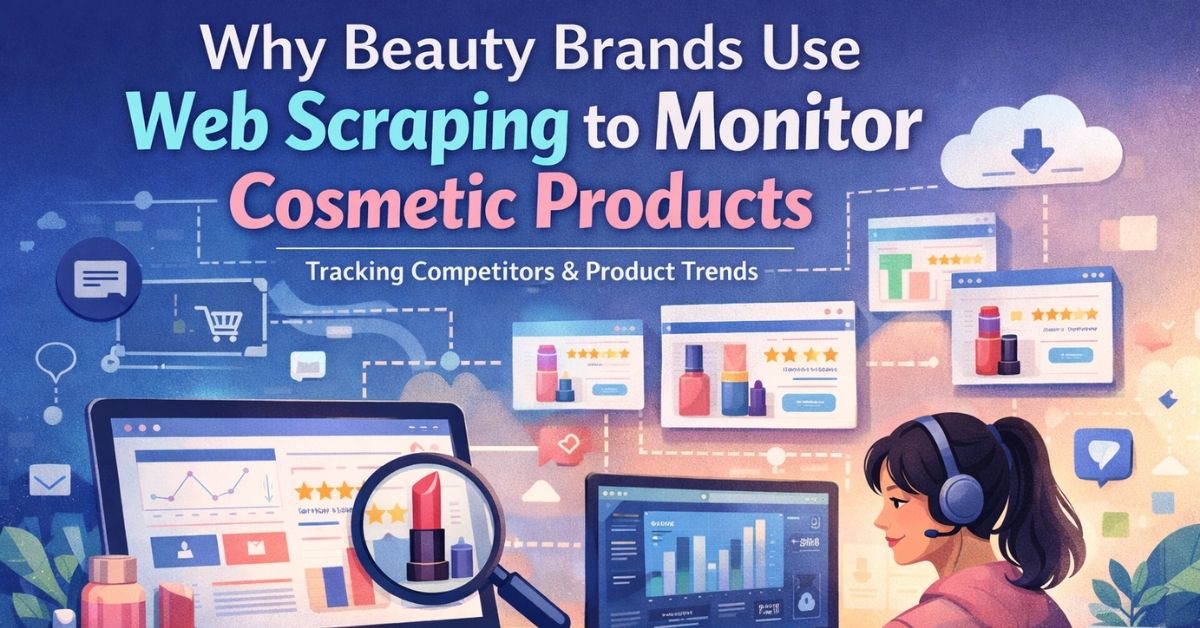
Beauty is a data-heavy business. Prices change daily. New launches appear overnight. Consumer sentiment shifts fast. Brands that rely on manual tracking fall behind. Web scraping fixes that problem.
For modern beauty brands, success depends on how quickly they can identify trends and insights across e-commerce platforms, marketplaces, and competitor sites. Web scraping provides continuous visibility into cosmetic products, pricing, availability, and consumer feedback. It turns scattered online information into structured intelligence that teams can actually use.
Here is the reality of why serious beauty brands rely on web scraping.
1. Real-time price intelligence
Online prices are volatile. Marketplaces, retailers, and resellers constantly adjust rates based on demand, inventory levels, and promotions. Manual checks cannot keep up with this pace.
Web scraping helps brands:
- Track competitor prices daily or even hourly
- Spot undercutting, flash discounts, or pricing violations
- Maintain pricing consistency across multiple sales channels
- Protect premium positioning and brand value
Without real-time price data, pricing decisions are based on assumptions. With scraping, pricing becomes a controlled, data-led function.
2. Monitoring product availability
Out-of-stock issues directly impact revenue, customer trust, and brand perception. At the same time, unexpected availability from unauthorized sellers creates compliance risks.
Web scraping allows brands to:
- Monitor stock status across retailers and marketplaces
- Detect grey-market or unauthorized sellers
- Identify supply chain gaps before they escalate
- Understand regional availability patterns
This turns inventory management from a reactive exercise into a proactive process. Teams can respond faster to stockouts, distribution issues, and seller violations.
3. Competitive product tracking
The beauty market moves fast. Competitors launch new products, reformulate existing ones, and update claims frequently. Missing these changes means losing ground.
Web scraping captures:
- New product launches across categories
- Ingredient lists and product claims
- Packaging updates and rebranding efforts
- Variant expansions such as new shades or sizes
Brands use this intelligence to benchmark offerings, identify gaps, and plan smarter launches. Competitive tracking becomes continuous instead of quarterly.
4. Review and sentiment analysis
Customer feedback does not live in one place. It is spread across brand websites, ecommerce platforms, forums, and review sites.
Scraping reviews helps brands:
- Identify recurring complaints and product issues
- Track sentiment at the product and category level
- Detect formulation or quality problems early
- Improve messaging based on real consumer language
This is an unfiltered consumer truth. When analyzed properly, review data directly informs product development, quality control, and marketing strategy.
5. Trend detection at scale
Beauty trends often start quietly and scale rapidly. By the time a trend is obvious, it is usually too late to lead.
Scraped data reveals:
- Rising ingredients such as peptides, ceramides, or niacinamide
- Growing demand for formats like sticks, mists, or refill packs
- Shifts toward clean, vegan, or dermatologist-backed claims
- Changes in consumer preferences across regions
Brands that identify trends early gain an advantage in product planning, content creation, and search visibility. Trend detection becomes measurable, not speculative.
6. Marketplace and compliance control
Unauthorized sellers, counterfeit listings, and pricing violations damage both margins and reputation. Manual policing does not scale.
Web scraping helps brands:
- Detect sellers violating pricing and distribution rules
- Track counterfeit or misleading listings
- Monitor compliance across multiple marketplaces
- Protect consumer trust and brand credibility
This is especially critical for premium and dermatology-led brands, where trust is a core asset.
How BeautyFeeds.io Supports Web Scraping for Cosmetic Product Monitoring
For beauty brands that want to move from raw data to usable intelligence, BeautyFeeds.io operates at the intersection of web scraping, ecommerce data, and decision-ready insights.
BeautyFeeds.io is not just about collecting data. It focuses on structuring, validating, and operationalizing cosmetic product data at scale. This ensures teams spend less time cleaning data and more time acting on it.
Price and availability monitoring at scale
BeautyFeeds.io enables continuous tracking of cosmetic product prices and availability across markets and retailers.
This helps brands:
- Detect price inconsistencies and policy violations
- Track discounting patterns across channels
- Monitor stockouts and replenishment signals
- Identify unauthorized or gray-market listings
This directly supports revenue protection, marketplace governance, and smarter pricing decisions.
Turning scraped data into usable intelligence
Web scraping alone creates raw signals. Raw signals are noisy and hard to use.
Beauty Feeds converts scraped data into structured, reliable product intelligence that can be integrated into dashboards, analytics tools, and internal workflows.
For beauty brands, this means:
- Faster and more confident decisions
- Fewer blind spots across ecommerce and marketplaces
- Stronger pricing, product, and content strategies
- Better alignment across SEO, ecommerce, analytics, and product teams
Final thoughts
Beauty brands that win today operate like data-driven organizations.
Web scraping is not a shortcut. It is infrastructure. It replaces assumptions with evidence. It enables faster decisions. It creates a competitive advantage at scale.
Brands that ignore web scraping react late. Brands that invest in structured product intelligence lead.