Luxury beauty retailers stay competitive in a discount-driven market by using real-time competitor data to protect margins, selectively discount, and communicate value instead of price. With Beauty Feeds datasets, they can track competitor pricing, launches, stock levels, and positioning at scale, then turn that data into smart pricing and promotional decisions without diluting the brand.
What’s Really Going Wrong for Luxury Beauty Retailers?
Luxury beauty is under pressure from aggressive discounts, marketplaces, and price-savvy shoppers, but copying discounts blindly damages perceived exclusivity and margins. The real problem is not “high prices” but a lack of visibility into how competitors price, promote, and position their products across regions and channels.
Common pain points we can see in the article:
- We don’t know when competitors change prices or run flash sales until it’s too late.
- If we match discounts, we hurt margins. If we don’t, we lose traffic and conversions.
- Pricing is still driven by gut feeling, not data.
- Our teams spend hours in spreadsheets pulling price and product data from multiple websites.
This is exactly where Beauty Feeds’ real-time beauty product datasets and APIs become the backbone of a smarter strategy.
How Do Luxury Beauty Retailers Compete Without Joining a Price War?
1. Use Competitor Price Data to Set Smart, Not Cheap, Prices
Luxury leaders like Flaconi and THG rely on competitive data and AI to optimize pricing across thousands of SKUs and multiple markets, updating prices daily while protecting margins. The winning move is to price with context, not in isolation.
With Beauty Feeds datasets, a luxury retailer can:
- Monitor competitor prices for equivalent SKUs and close substitutes across key retailers.
- Identify “key value items” (KVI) where price visibility is high and staying competitive truly matters.
- Maintain a premium on halo and niche products while staying sharp on KVIs only.
If you’re worried that “we’ll lose customers if we don’t discount everything,” start by using Beauty Feeds datasets to find the 10–20% of SKUs where customers actually compare prices, and only compete aggressively there.
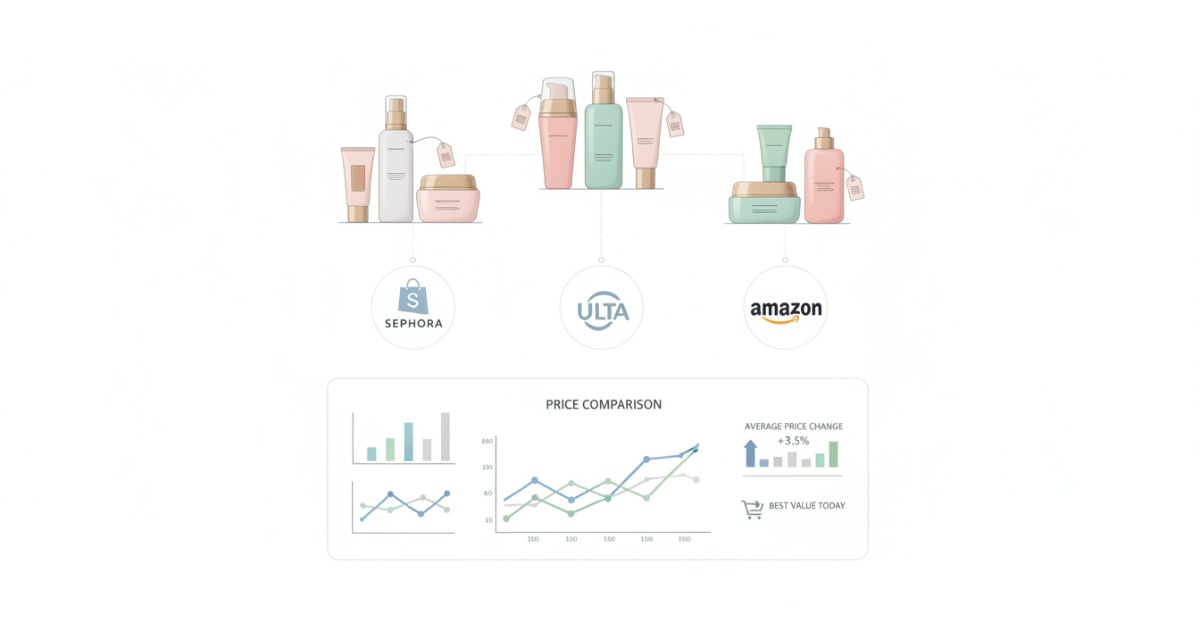
Want to see which of your SKUs are over- or under-priced versus competitors? Use a Beauty Feeds pricing dataset to benchmark your catalog in a single Excel or BI dashboard.
2. Protect Brand Equity with Targeted, Data-Led Promotions
Luxury brands cannot afford to “always be on sale” without eroding perceived value. The alternative is surgical discounting backed by data.
Using Beauty Feeds datasets and API, retailers can:
- Track when competitors run category-specific or brand-specific promotions in real time.
- Identify promotion patterns (weekends, month-end, seasonal events) and avoid head-to-head discount clashes unless strategically necessary.
- Design promotions that add value (bundles, gifts with purchase, loyalty offers) instead of pure markdowns.
If your team says, “We just copy competitor discounts during big events,” you’re leaving money on the table. Use historical Beauty Feeds data to see how deep competitors discount and when, then design smarter campaigns that compete where it matters and keep full-price where you can.
Download a sample Beauty Feeds promotion and pricing dataset to map out your next campaign calendar against real competitor behavior—not guesses.
3. Respond Faster Than the Market to New Launches and Stock Changes
In luxury beauty, new launches and exclusives are often more important than price for loyal customers. Retailers lose share when they react slowly to competitor launches, restocks, and product expansions.
Beauty Feeds helps you:
- Track competitor URLs and automatically detect new product launches and range extensions.
- See stock status changes—when competitors go out of stock, you can stay premium-priced and still win conversions.
- Spot gaps in your assortment when a competitor launches in a subcategory you don’t yet cover.
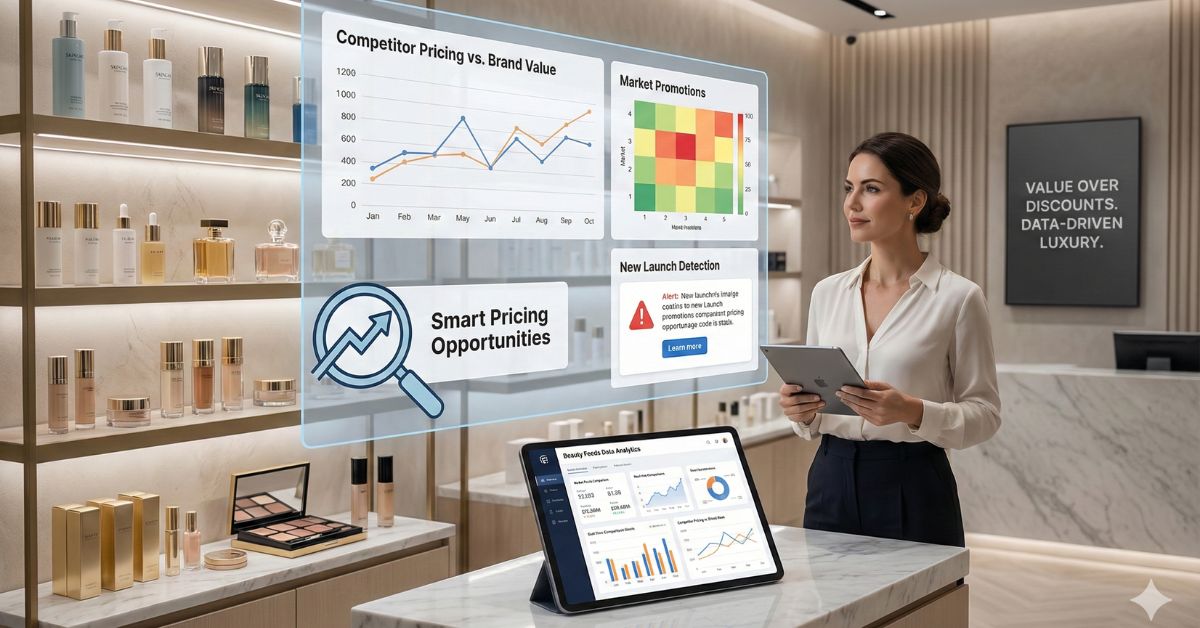
If you’ve ever said, “We found out about that competitor launch on social media weeks later,” the fix is to plug Beauty Feeds into a simple dashboard that alerts you when new SKUs, price changes, or out-of-stock events occur on competitor sites.
Set up competitor URL tracking with Beauty Feeds and turn manual market monitoring into automated alerts your team can actually act on.
4. Use Market Data to Justify Premium Pricing, Not Apologize for It
Luxury brands win when they sell value, not discounts. But to justify a premium, you need data to support the story.
With Beauty Feeds product and review datasets, you can:
- Compare your product’s ingredients, claims, and formats with cheaper alternatives to show why a higher price is justified.
- Analyze review velocity and ratings to identify products where customers are willing to pay a premium for experience, packaging, or efficacy.
- Build marketing messages like “premium actives at lower dosage elsewhere” or “more ml per use vs. competitor.”
If stakeholders ask, “Can we really hold this price when others discount?”, use Beauty Feeds data to show that your formula, reviews, and format deliver more value per use than discounted competitors—so the price is anchored in facts, not feelings.
Use a Beauty Feeds dataset to build a simple “value vs. price” comparison deck for your top 50 SKUs and take it into your next pricing meeting.
5. Turn Datasets into Always-On Pricing Intelligence
The biggest competitive advantage is not a single price change—it’s building a continuous, data-driven pricing muscle.
Luxury beauty retailers can use Beauty Feeds to:
- Pull clean, normalized data across 20+ beauty retailers with 40+ fields (price, ingredients, category, brand, availability, etc.).
- Feed that data into pricing engines, BI tools, or custom dashboards (Excel, Google Sheets, Python, R, SQL, Tableau).
- Move from monthly or ad hoc checks to weekly or even daily competitive insights without burdening teams.
If your pricing review still happens “once a quarter in a massive Excel,” you’re already behind competitors who update daily using structured datasets and AI. Start by automating data collection with Beauty Feeds and then layer analytics on top.
Ready to stop guessing and start pricing like a data-driven luxury leader?
- Explore Beauty Feeds’ beauty product and competitor datasets.
- Pick your core markets and key competitors.
- Request a tailored sample dataset and build your first pricing and promotion dashboard this week.
Compete on Intelligence, Not Just Discounts
Luxury beauty retailers don’t win by being the cheapest—they win by being the most informed. When you plug Beauty Feeds datasets into your pricing, promotion, and assortment decisions, you can stay premium, stay relevant, and still thrive in a discount-driven market.