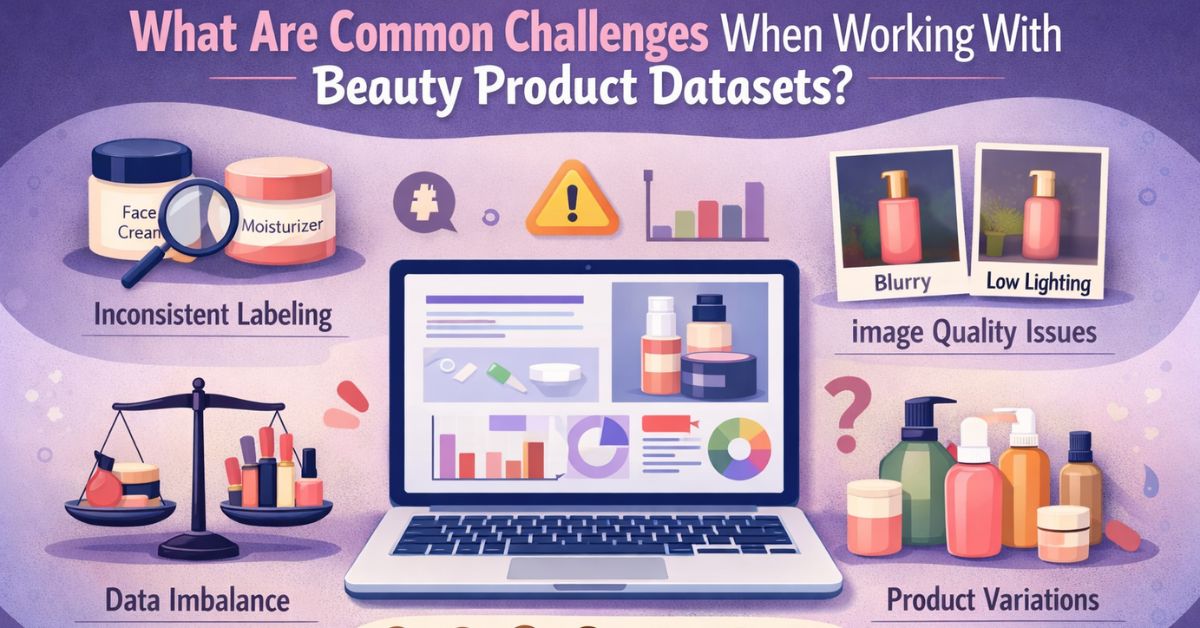
Beauty product datasets often look rich on the surface but break down during analysis. Common challenges include inconsistent attributes, missing data, messy taxonomy, compliance risks, and frequent product updates. These issues affect reporting, search accuracy, trend analysis, and model performance if left unresolved.
Why Beauty Product Datasets Are Harder Than They Look
Beauty and cosmetics data is unique. It mixes emotional language with technical claims.
Products vary by shade, skin type, region, and regulation. New launches happen fast. Discontinued items disappear quietly.
As a result, beauty product datasets often suffer from structural and semantic issues that slow teams down.
1. Inconsistent Product Attributes Across Brands
One of the biggest challenges in beauty product datasets is inconsistency.
The same attribute appears in multiple formats:
- “Skin Type” vs “Suitable For”
- “Finish” vs “Texture”
- “Shade” vs “Color Name”
Even ingredient lists vary in naming and order.
Why this is a problem
- Breaks filtering and faceted search
- Reduces accuracy in comparison analysis
- Confuses ML models and dashboards
How to solve it
- Create a standardized attribute dictionary
- Normalize values during ingestion
- Use controlled vocabularies for finish, skin type, and concern
- Apply mapping rules at the brand level
A clean schema improves every downstream use case. One of the most effective ways to solve attribute inconsistency is by working with structured beauty product datasets, where fields are normalized across brands and categories. Instead of manually mapping attributes like skin type or finish, teams can rely on standardized schemas that improve filtering, analytics, and model performance.
2. Missing or Incomplete Data Fields
Many beauty product datasets lack critical fields:
- Full ingredient lists
- Shade ranges
- Usage instructions
- Skin concern tags
This happens often with scraped or third-party data.
Why this is a problem
- Limits personalization and recommendations
- Skews analytics outputs
- Weakens category-level insights
How to solve it
- Set minimum completeness thresholds
- Flag incomplete records automatically
- Enrich datasets from multiple trusted sources
- Use validation rules before data is published
- Completeness beats volume every time.
3. Unstructured Ingredient and Claim Data
Ingredients and claims are rarely structured well.
They appear as long text blocks:
- “Free from parabens, sulfates, and phthalates”
- “Infused with vitamin C and hyaluronic acid”
Why this is a problem
- Hard to analyze trends
- Difficult to build filters or compliance checks
- Poor performance in NLP tasks
How to solve it
- Parse ingredients into structured lists
- Tag claims using predefined categories
- Separate marketing language from factual data
- Maintain a reference list for ingredient aliases
This step is critical for serious beauty data analysis.
4. Taxonomy and Category Mismatch
Beauty categories change across platforms.
A product can be labeled as:
- Skincare on one site
- Personal care on another
- Dermocosmetics elsewhere
Why this is a problem
- Inconsistent reporting
- Broken category-level insights
- Search and navigation issues
How to solve it
- Build a master taxonomy
- Map external categories to internal ones
- Version control taxonomy updates
- Review category logic quarterly
Stable taxonomy keeps datasets usable long-term.
5. Regulatory and Compliance Risks
Beauty data is tightly regulated.
Claims, ingredients, and labeling rules differ by region:
- EU
- US
- Asia-Pacific
Why this is a problem
- Legal exposure
- Incorrect claims analysis
- Dataset misuse across markets
How to solve it
- Store region-specific compliance flags
- Separate global vs local claims
- Track regulation sources at field level
- Avoid merging datasets across regions blindly
Compliance awareness must be built into the dataset itself.
6. Frequent Product Updates and Version Drift
Beauty products change fast.
Formulas improve. Packaging updates. Shades expand.
Datasets often mix old and new versions without clarity.
Why this is a problem
- Inaccurate trend analysis
- Broken historical comparisons
- Confusing product matching
How to solve it
- Add product versioning
- Track update timestamps
- Use stable product IDs
- Archive deprecated records instead of deleting them
Version control protects analytical accuracy.
7. Duplicate and Near-Duplicate Records
Duplicates are common in beauty product datasets.
Causes include:
- Multiple retailers
- Slight naming differences
- Bundle vs single items
Why this is a problem
- Inflated counts
- Misleading insights
- Model bias
How to solve it
- Use fuzzy matching on names and ingredients
- Create canonical product records
- Merge duplicates using rule-based logic
- Retain source references
Clean datasets start with deduplication.
Best Practices for Managing Beauty Product Datasets
To avoid repeated issues:
- Define schema before collecting data
- Validate data at every ingestion step
- Document assumptions and mappings
- Monitor data drift monthly
- Treat datasets as living assets
Strong foundations reduce future rework.
Final Thoughts
Beauty product datasets come with unique challenges. Inconsistency, missing data, taxonomy issues, and compliance risks can quickly derail analysis. With clear standards, structured enrichment, and ongoing validation, these problems are solvable. The result is reliable data that supports better insights, smarter decisions, and scalable growth.