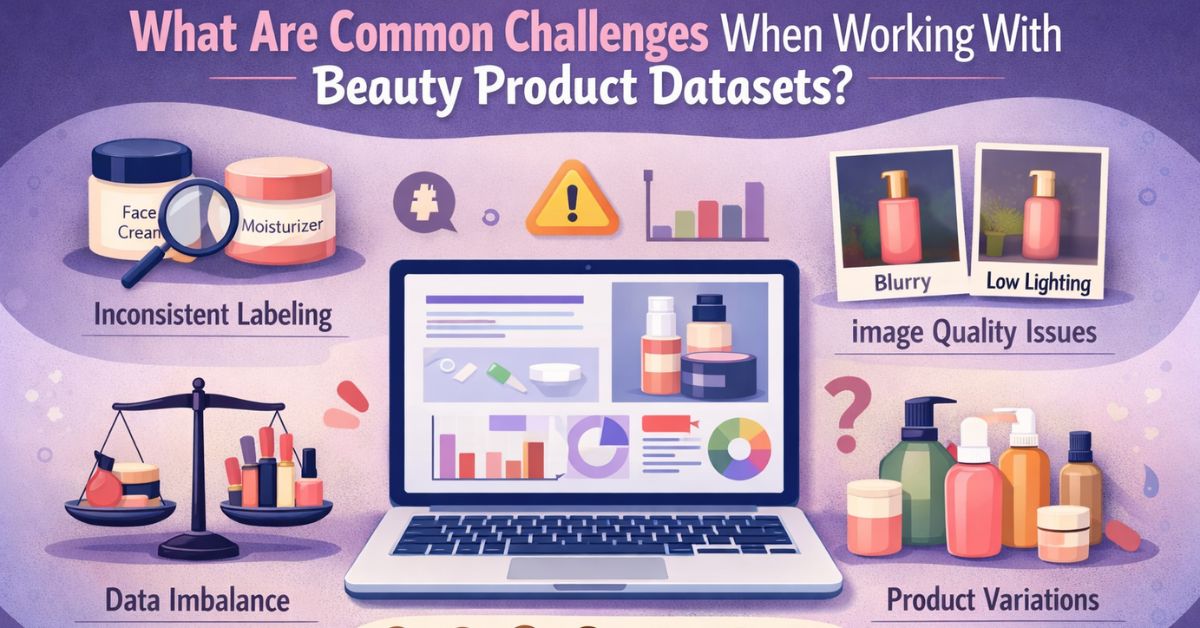
AI can analyze thousands of beauty product changes by processing structured product data collected over time and identifying patterns across prices, SKUs, ingredients, availability, reviews, descriptions, and launches. Instead of manually comparing thousands of product pages, brands can use beauty product datasets to detect changes, classify them, and turn them into competitive insights.
What Counts as a Beauty Product Change?
A product change is any meaningful difference between two product-data snapshots. With beauty product datasets, brands can track changes such as:
- New products and SKUs
- Discontinued products
- Price increases or decreases
- Discounts and promotions
- Stock and availability changes
- Product description updates
- Ingredient or formulation changes
- New shades, variants, or sizes
- Rating and review changes
- Retailer availability changes
This makes product monitoring more useful than simply maintaining a static catalog. Historical beauty product data allows brands to understand how products evolve over time.
Why AI Needs Structured Beauty Product Data
AI models can identify patterns much more effectively when product information is organized into consistent fields.
Consider a dataset containing:
Instead of manually reviewing thousands of product pages, a model can compare structured records, identify differences, group similar products, and summarize the changes.
This is one of the major advantages of beauty product datasets. They transform information from individual webpages into data that can be analyzed across brands, retailers, categories, and time periods.
BeautyFeeds provides structured beauty market data covering pricing, stock, ingredients, reviews, and product information across major beauty retailers.
How Beauty Product Datasets Support AI Analysis
Product Data for Product Intelligence
Product-level beauty product datasets can help identify:
- Category expansion
- New product launches
- Assortment changes
- New variants and sizes
- Brand expansion into new categories
- Common product attributes
For example, if a competitor adds multiple barrier-repair products within a short period, the change may indicate a strategic focus on that category.
Competitor product monitoring commonly tracks new SKUs, product listings, pricing, availability, descriptions, and product removals.
Pricing Data for Competitive Pricing
Pricing data allows brands to analyze:
- Competitor price changes
- Discounts and promotions
- Premium versus mass-market positioning
- Price gaps between competing products
- Promotional patterns
This makes beauty competitor price tracking more actionable. Instead of knowing that a competitor sells a serum for $35, a brand can determine whether the price increased from $30, dropped from $40, or has remained stable for several months.
BeautyFeeds supports price tracking and change detection across beauty retailers, including historical pricing and promotional signals.
Review Data for Customer Intelligence
Reviews contain valuable information that cannot be captured through product specifications alone.
AI can process large volumes of review data to identify:
- Common complaints
- Frequently praised product attributes
- Emerging customer needs
- Sentiment changes
- Frequently mentioned ingredients
- Recurring product problems
For example, thousands of reviews might reveal that customers consistently like a moisturizer's texture but complain about its packaging. That pattern can become a product-development insight.
Ingredient Data for Formulation Intelligence
Ingredient-level beauty product datasets allow brands to compare formulations across products and competitors.
Analysis can identify:
- Trending ingredients
- Common ingredient combinations
- Emerging formulations
- Competitor formulation patterns
- Ingredients appearing in newly launched products
Because ingredient lists can be normalized into structured fields, brands can compare products across retailers rather than manually inspecting individual ingredient lists. BeautyFeeds specifically provides normalized ingredient data for analysis and filtering.
Availability Data for Demand Signals
Stock and availability changes can also provide useful market signals.
Brands can analyze:
- Frequently unavailable products
- Repeated stockouts
- Retailer distribution changes
- Restock patterns
- Product lifecycle changes
A single stockout does not necessarily indicate high demand. However, repeated availability changes across retailers, combined with pricing and review data, can provide stronger evidence of product momentum.
How AI Detects Beauty Product Changes Over Time
The key is comparing product data snapshots over time.
For example:
January
Product A
Price: $30
Stock: In stock
Reviews: 20
Price: $30
Stock: In stock
Reviews: 20
↓
February
Product A
Price: $34
Stock: Out of stock
Reviews: 85
Price: $34
Stock: Out of stock
Reviews: 85
↓
March
Product A
Price: $34
Stock: In stock
Reviews: 210
Price: $34
Stock: In stock
Reviews: 210
The system can identify a 13.3% price increase, temporary stock shortage, and significant growth in review volume.
The valuable output is not simply the raw data. It is the interpretation of what changed and why that change may matter.
How Beauty Product Datasets Improve Competitor Intelligence
Brands can combine beauty product datasets with competitor URL tracking to monitor thousands of product pages at scale.
A useful workflow looks like this:
BeautyFeeds → Structured product data → AI analysis → Competitive insight → Business decision
The data layer provides product information, prices, availability, ingredients, and reviews. AI can then classify changes and identify patterns.
For example, a beauty brand could discover that a competitor has:
- Launched five new skincare SKUs
- Reduced prices on three existing products
- Expanded into a new category
- Introduced a trending ingredient
- Experienced repeated stock shortages
This creates a much clearer picture of competitor strategy than manually checking websites.
What Can Brands Ask AI About Beauty Product Data?
Once beauty product datasets are available, teams can ask highly specific questions such as:
- Which competitors launched new skincare products in the last 30 days?
- Which beauty categories have the highest number of new SKUs?
- Which competitors reduced prices by more than 10%?
- Which ingredients appear most frequently in newly launched serums?
- Which products experienced repeated stock shortages?
- What attributes are common among highly rated competitor products?
- Which beauty categories appear underserved based on competitor assortment?
These questions turn large volumes of product records into practical competitive intelligence.
Use BeautyFeeds for Large-Scale Beauty Product Analysis
Analyzing thousands of beauty product changes requires reliable, structured data. Beauty product datasets provide the foundation for comparing products, pricing, ingredients, reviews, availability, and assortment changes across retailers.
BeautyFeeds provides structured beauty market data through datasets and APIs, covering product records, pricing, ingredients, reviews, stock information, and multiple beauty retailers.
For brands, retailers, researchers, and product teams, the goal is not simply to collect more data. It is to make product changes easier to detect, compare, and interpret.
Explore BeautyFeeds beauty product datasets to turn large-scale product data into actionable beauty market intelligence.