




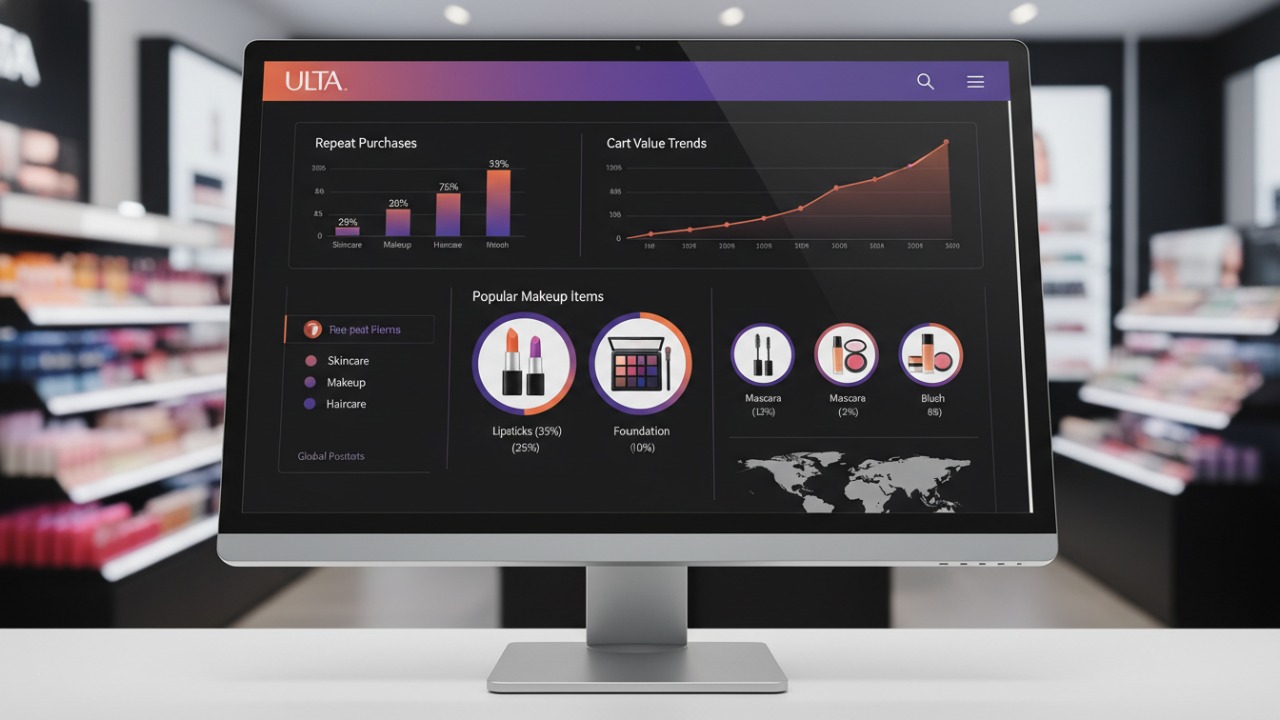
You can spend months surveying beauty shoppers, or you can let the data tell you what they already did.
Ulta Beauty’s product catalog, pricing history, ratings, reviews, and availability data contains dense behavioral signals. Every rating is a vote. Every review is a preference statement. Every price shift is a market test with a real consumer response baked in.
Over 95% of Ulta Beauty’s total sales come from identifiable loyalty members, meaning marketing operates on a known customer base with consistent measurement, personalization, and lifecycle control at scale. That level of purchase identity creates a data trail most retailers can only aspire to.
Ulta achieved a 95% repeat customer rate after centralizing its data from emails, loyalty programs, and in-store silos into unified customer profiles, then deploying AI and machine learning models to predict what customers are likely to do next.
The behavioral intelligence is in the data. Here are 7 specific ways to extract it.
Why Ulta Beauty Data Is Particularly Valuable for Behavior Analysis
Most beauty datasets give you a flat product list. Ulta’s data is layered.
A structured Ulta Beauty dataset includes product URLs, titles, SKUs, pricing, availability, customer reviews, ingredients, categories, descriptions, and how-to-use information, making it relevant for e-commerce analytics, competitor research, and digital marketing.
That combination of product attributes plus customer feedback fields is what makes Ulta data useful for behavioral analysis, not just product cataloging. You’re not just seeing what exists. You’re seeing what customers chose, rated, and responded to.
Ulta generated $2,455 million in online revenue in 2025, with a site conversion rate of 3.5–4.0%, and 17% of its customer base in the 18–24 age group.
That’s a large, active, demographically documented customer base. The product and review data reflects their real purchasing behavior at scale.
1. Rating Distribution Analysis to Map Satisfaction by Category
Start with the most direct behavioral signal available: how customers actually rate products after buying them.
Don’t look at average ratings in isolation. Look at the distribution.
A category with a high average rating but tight clustering around 3–4 stars signals moderate satisfaction across the board. No breakout products, no clear leaders. A category where ratings cluster at either 5 stars or 1–2 stars tells a very different story: strong winners, strong losers, and a polarized customer base.
What to map:
- Average rating by primary category (skincare, haircare, makeup, fragrance)
- Rating standard deviation per subcategory
- Products with 4.5+ stars AND 100+ reviews. That combination signals validated quality, not just a few enthusiastic early reviews
Ulta’s machine learning algorithms analyze 3.6 million customer beauty profiles, providing personalized product recommendations with a 68% accuracy rate, while its Ultimate Rewards program generates $1.3 billion in loyalty-driven sales representing 22.7% of total company revenue.
The rating patterns in the public product data reflect the same preferences that drive Ulta’s internal personalization. Your analysis surfaces the same signals.
2. Review Volume vs. Rating Score: The Trust Quadrant
Review count and rating score together create a four-quadrant behavioral map that most analysts never build.
| Quadrant | Signal | Action |
| High rating + high reviews | Validated winner. Customer consensus | Benchmark for the category |
| High rating + low reviews | Promising but unproven. Watch it | Monitor over time |
| Low rating + high reviews | Known problem at scale | Avoid or study what went wrong |
| Low rating + low reviews | Insufficient data | Exclude from trend analysis |
The top-left quadrant (high rating, high reviews) shows you what Ulta customers have collectively decided works. These products represent validated demand, not algorithmic promotion.
The bottom-right quadrant of low-rated, high-review products is equally important. Ulta uses AI and machine learning to predict what customers are likely to do next based on unified customer profiles. Products with high review volume and poor ratings are ones customers tried in volume and rejected. That’s a category or formulation problem, documented in public data.
Build this quadrant map for every major subcategory. The patterns reveal where customer satisfaction is strong, where it’s broken, and where opportunity exists.
3. Price Point Clustering to Understand Willingness to Pay
Ulta’s catalog spans mass-market to prestige within the same category. That price spread is a behavioral dataset in itself.
Pull pricing across a category (serums, for example) and plot the distribution. You’ll find natural clustering points where products concentrate. Those clusters represent price anchors. They’re where enough customers have consistently purchased to validate that specific price-to-value expectation.
What the clusters tell you:
- Dense clustering at $15–$30. Mass-market positioning dominates. Customers in this category are price-sensitive.
- Dense clustering at $60–$90. Premium tier is accepted. Customers believe efficiency requires investment.
- Thin distribution in the middle. A gap that represents either untapped opportunity or a “no man’s land” that customers skip.
Ulta’s conversion rate reached 3.5–4.0% in 2025, with pricing and payment options playing a major impact on customer satisfaction.
Cross price clustering with average rating by price tier and you get the most actionable insight in the dataset: where customers pay more AND rate higher. That’s the price tier with the best customer satisfaction ROI.
4. Availability and Stock Status Patterns as Demand Signals
This is the analysis almost no one runs on Ulta data, but it’s one of the most reliable behavioral signals in the dataset.
When a product is repeatedly listed as “out of stock” or shows availability fluctuations in the data, that’s demand exceeding supply. It’s customers trying to buy and finding nothing there.
What to track:
- Products cycling between in-stock and out-of-stock within the same category
- Products showing “limited availability” flags across multiple data pulls
- Categories with higher out-of-stock rates than others
High stock-out frequency in a subcategory tells you two things: customer demand is real and consistent, and supply is not keeping up. For product teams, that’s a launch signal. For analysts, it’s a category health indicator.
Ulta’s loyalty program provides valuable customer data enabling the retailer to understand shopping behavior and preferences, which has allowed Ulta to personalize marketing efforts and suggest products that align with customers’ interests.
That internal demand intelligence is partially visible in the public availability data. You don’t need loyalty program access to see where demand is outpacing supply.
5. Ingredient Frequency Analysis as a Preference Proxy
Review and rating data tells you what customers liked. Ingredient data tells you what they were buying based on claimed benefits.
Run a frequency count on ingredient lists across the top-rated products in a category. Which activities appear most often in high-performing SKUs? Which appear in products that rate poorly?
Ulta Beauty’s ingredient-focused product dataset includes detailed ingredient lists ideal for product transparency tools, clean label research, and beauty data modeling, covering fields like ingredients, raw ingredients, category, highlights, how-to-use, and description.
Two analyses worth running:
Correlation analysis. Does the presence of a specific ingredient (niacinamide, hyaluronic acid, retinol) correlate with higher average ratings within a category? If yes, customers are responding positively to that activity. If not, the ingredient is present but not driving satisfaction.
Absence analysis. What ingredients are absent in high-rated products that appear frequently in low-rated ones? Fragrance, alcohol, and certain preservatives often appear more frequently in lower-rated skincare. That absence pattern is a behavioral signal about what customers avoid, not just what they prefer.
6. Brand Performance Benchmarking Within Category
Ulta carries both mass-market and prestige brands side by side. That makes it one of the few retail contexts where you can benchmark brand performance directly against each other under the same shopping conditions.
Pull average rating, review volume, price point, and SKU count by brand within a subcategory. The patterns that emerge tell you exactly how customers are evaluating brands when the playing field is level.
Key ratios to calculate:
- Review-to-SKU ratio. Total reviews divided by SKU count. High ratio means customers are engaging deeply with a smaller catalog. Low ratio means a wide catalog with shallow engagement.
- Rating-to-price ratio. Average rating divided by average price. Brands scoring high here deliver perceived value above their price point. Brands scoring low are underdelivering on their price positioning.
- Category concentration. Is a brand’s review volume concentrated in one subcategory or spread across many? Concentrated review volume indicates a specialist brand with a core customer. Diffuse volume indicates a generalist brand with lower category depth.
Millennials and Gen Z represent 68% of Ulta Beauty’s customer base, with social media influencing 87% of beauty product purchases.
Brand performance patterns in the data reflect these demographics. Brands winning with Gen Z customers show it in review velocity (many reviews in short timeframes) and rating polarization (very high or very low, reflecting strong opinions rather than passive satisfaction).
7. Description and Product Naming Pattern Analysis
This is the behavioral analysis that requires the most work but returns insights on other method surfaces.
Product names and descriptions on Ulta aren’t written arbitrarily. They’re written to convert. Brands choose ingredient-led naming (“10% Niacinamide Serum”), outcome-led naming (“Dark Spot Corrector”), or benefit-led naming (“Hydrating Barrier Cream”) based on what they believe resonates with their target customer.
When you analyze which naming and description patterns appear in top-performing products (by rating AND review volume), you’re analyzing which language framing drives the most customer engagement and purchase confidence.
Patterns worth extracting:
- Do outcome-led product names outperform ingredient-led names by rating in specific categories?
- Do products with “how to use” instructions included in the description rate higher than those without?
- Do products mentioning specific concerns (acne, sensitivity, dark spots) in the name attract more reviews than generic names?
Ulta considers data-driven insights generated by AI to be a major advantage for its personalized beauty experiences, achieving meaningful customized suggestions that drive traffic to purchase through a custom-built machine learning framework.
That machine learning framework is trained on the same product and behavioral data you’re analyzing. The naming and description patterns that appear in high-converting products reflect what Ulta’s system has already identified as effective. Your analysis is a reverse-engineering of that signal.
The Data Problem Behind All 7 Analyses
Every analysis above requires a consistent, structured Ulta Beauty dataset with complete fields: ratings, review counts, prices, availability, ingredients, descriptions, categories, and timestamps.
Most teams hit one of two walls. Either the dataset they’re working from is a static snapshot that’s months old, making trend and availability analysis meaningless. Or the data is raw and inconsistent with missing fields, unstandardized categories, and ingredient lists that vary in format across products.
Both problems stop the analysis before it starts.
This is where having a clean, structured starting point matters more than the analytical method. If you’re building a customer behavior analysis workflow, a competitive benchmarking model, or a product strategy brief and your current data source has gaps, BeautyFeeds.io sample datasets give you a solid foundation to start from.
Fields include product name, brand, category, ingredients, certifications, pricing, availability, ratings, review counts, and update timestamps across skincare, cosmetics, haircare, and fragrance. Structured, clean, and formatted to work with spreadsheets, BI tools, or ML pipelines without a manual cleaning project sitting between you and the insight.
Download free structured beauty product datasets →
What to Do With These 7 Analyses
Each of the seven frameworks above works as a standalone project. Together, they build a complete behavioral picture of what Ulta Beauty customers value, what frustrates them, what they pay for, and what they avoid.
Here’s a simple prioritization guide:
| Your goal | Start with |
| Competitive product benchmarking | Way 3 (price clustering) + Way 6 (brand benchmarking) |
| New product development | Way 1 (rating distribution) + Way 5 (ingredient frequency) |
| Category market entry | Way 2 (trust quadrant) + Way 4 (availability patterns) |
| Marketing and messaging strategy | Way 7 (description analysis) + Way 6 (brand performance) |
| Full customer behavior audit | All 7, in order |
Final Word
Ulta Beauty data doesn’t just describe a product catalog. It documents millions of customer decisions. With over 95% of sales tied to identifiable loyalty members, Ulta’s data reflects a known customer base with consistent, measurable behavior across every channel.
Every rating, review, price point, ingredient, and availability flag in that dataset is the output of a real decision a real customer made.
The seven analyses above are how you turn those decisions into direction.