




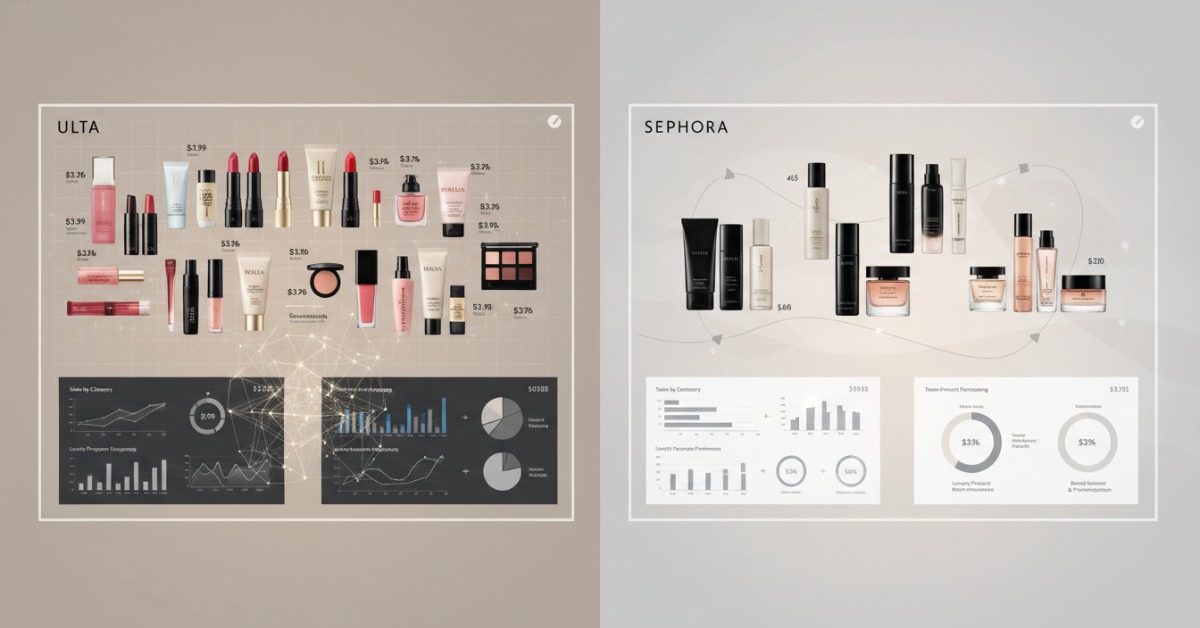
When comparing Ulta vs Sephora dataset value, Ulta often provides richer insights due to its pricing diversity, wider customer base, and omnichannel data. For businesses analyzing beauty retail trends, Ulta’s dataset offers more actionable signals for segmentation, pricing strategy, and demand forecasting.
Ulta vs Sephora Dataset: Quick Comparison Table
| Factor | Ulta Dataset | Sephora Dataset | Impact on Business |
| Product Range | Mass + Mid + Premium | Mostly Premium | Broader insights vs niche focus |
| Customer Base | Diverse income segments | Premium-focused users | Better segmentation vs limited personas |
| Pricing Data | Frequent discounts, varied pricing | Stable premium pricing | Strong pricing models vs limited variation |
| SKU Volume | High SKU count | Curated SKU list | More keyword/data coverage vs limited scale |
| Reviews | High volume, diverse feedback | Quality but less diverse | Better AI training data vs narrower sentiment |
| Omnichannel Data | Retail + Online + Services | Retail + Online | Full journey insights vs partial view |
| SEO Value | High keyword diversity | Limited keyword spread | Strong content scaling vs niche targeting |
| Use Cases | AI, pricing, forecasting, SEO | Luxury analysis, branding | More applications vs specialized use |
| Overall Strength | Scalability and data diversity | Premium precision | Growth-focused vs brand-focused |
Understanding the Ulta vs Sephora Dataset Landscape
Both Ulta and Sephora are dominant players in beauty retail. But their datasets reflect different business models.
- Sephora focuses on premium and luxury brands
- Ulta combines mass-market, drugstore, and premium brands
This structural difference directly impacts dataset depth.
Read more: 7 Ways to Analyze Customer Behavior Using Ulta Beauty Data
Key distinction:
Ulta’s dataset captures broader consumer behavior across income segments, while Sephora’s dataset is more niche.
1. Broader Product Range Means Richer Data Signals
Ulta’s product catalog spans:
- Drugstore brands (Maybelline, NYX)
- Mid-tier brands
- High-end luxury brands
This creates a multi-layered dataset.
Why it matters:
- Better price elasticity analysis
- Stronger demand modeling across segments
- More diverse keyword and search intent mapping
Sephora’s dataset is heavily skewed toward premium products, limiting variability.
2. Wider Customer Demographics = Better Segmentation
Ulta attracts:
- Budget-conscious buyers
- Mid-range shoppers
- Premium beauty consumers
This results in:
- More diverse purchasing behavior
- Broader review sentiment patterns
- Better audience segmentation opportunities
Sephora’s audience is more homogeneous, reducing dataset flexibility.
3. Stronger Pricing Intelligence in Ulta Dataset
Ulta’s pricing structure includes:
- Frequent discounts
- Coupons and promotions
- Tiered pricing across product categories
Benefits:
- Track discount-driven demand spikes
- Identify pricing thresholds for conversions
- Build competitive pricing models
Sephora offers limited pricing variation, reducing analytical depth.
4. Omnichannel Data Advantage
Ulta operates a true omnichannel model:
- Online store
- Physical retail locations
- Salon services
This creates a dataset that includes:
- Online behavior
- In-store purchase patterns
- Service-based interactions
You get a complete customer journey, not just ecommerce signals.
5. Higher SKU Volume Improves Data Coverage
Ulta carries more SKUs across categories, leading to:
- More keyword coverage for SEO
- Better long-tail search data
- Higher product comparison opportunities
6. Review Data Diversity and Volume
Ulta’s dataset includes higher review volumes across price tiers, resulting in:
- Better training data for AI models
- More nuanced sentiment clustering
7. Better Use Cases for AI and Analytics
Ulta dataset supports:
- Dynamic pricing models
- AI-based product recommendations
- Market basket analysis
- Demand forecasting
Sephora dataset is more suited for premium brand analysis.
8. SEO and Content Strategy Advantages
Ulta datasets offer:
- More keyword variations
- Broader search intent mapping
- Higher content scalability
Supporting Data Perspective
For businesses working with structured datasets like those from Crawl Feeds, Ulta-style datasets align better with scalable data strategies. They provide multi-dimensional insights across pricing, reviews, and inventory.
When Sephora Dataset Might Be Better
- Luxury brand benchmarking
- Premium consumer behavior analysis
- High-end product positioning
Final Takeaway: Scale vs Precision
- Ulta = Scale, diversity, flexibility
- Sephora = Precision, premium focus
Ulta’s dataset reflects real-world market complexity, making it more valuable for growth-focused strategies. Explore scalable beauty product datasets and start building data-driven insights.