




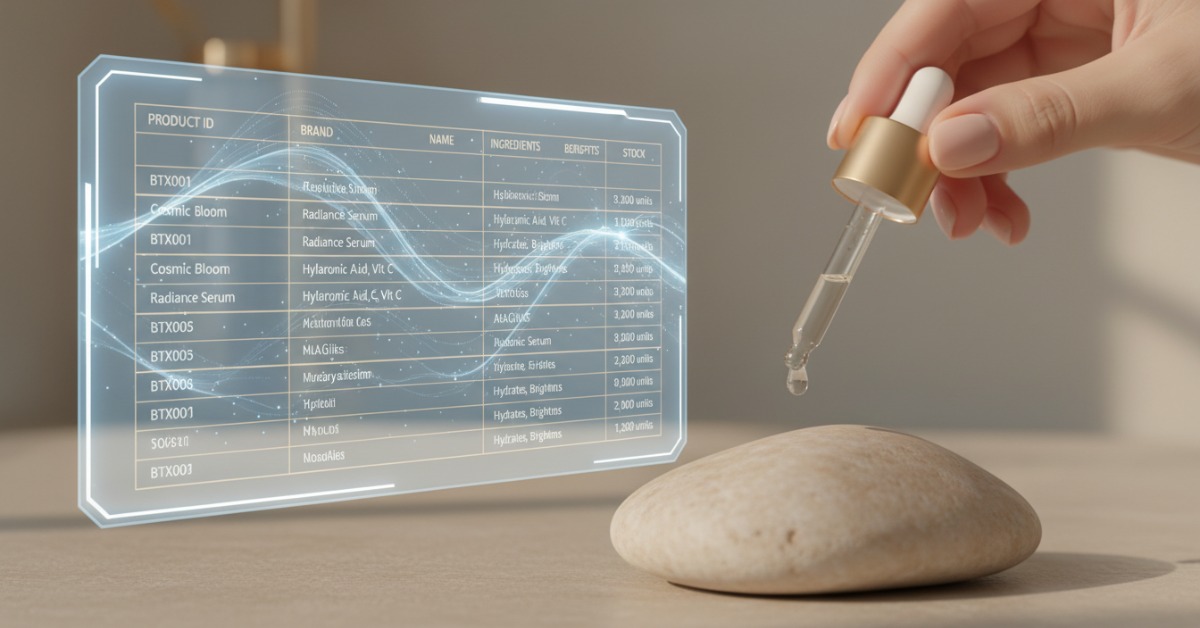
A shopper lands on your site. They have combination skin, hate fragrance, want clean beauty under $40, and have already returned two moisturizers this year.
Your product page shows them your bestsellers.
That’s the gap AI personal shoppers are built to close. But here’s what most brands don’t realize: the AI isn’t the hard part. The data is.
A 2025 consumer survey found that 76% of beauty shoppers are now open to using an AI-powered personal shopper, meaning the consumer side of the adoption barrier has largely collapsed (MegaOne AI). What separates brands that benefit from that shift from brands that don’t is the quality and structure of the beauty data powering their systems.
59% of beauty consumers already use AI tools when shopping, primarily for price checks, product comparisons, and finding dupes or alternatives. These consumers aren’t waiting for the industry to catch up. The brands that have structured, comprehensive beauty datasets are pulling ahead. The ones still relying on static product catalogs are falling behind.
This post breaks down exactly how beauty datasets train, fuel, and continuously improve AI personal shoppers, and what your data needs to look like to make it work.
Why the AI Is Only as Good as the Data Behind It
Most conversations about AI personal shoppers focus on the model: the algorithm, the architecture, the interface. That’s the wrong starting point.
Large language model chatbots trained on product data and consumer preferences can respond to a wider variety of questions and offer more personalized recommendations, both of which improve conversion rates. One global beauty brand deployed a gen-AI shopping assistant and saw conversion rates increase by as much as 20%.
The operative phrase is “trained on product data.” The model’s intelligence is a direct function of the data it was trained on. A recommendation engine built on sparse, inconsistent, or outdated product data produces generic outputs. One built on rich, structured beauty datasets. with ingredient-level detail, category taxonomy, certifications, skin type targeting, and pricing context. produces recommendations that feel like they came from someone who actually knows the customer.
The dataset is the product. AI is the delivery mechanism.
What a Beauty Dataset Needs to Include for AI Personalization
Not all beauty datasets are built for AI training. A flat product list with a name, price, and category won’t get you far. AI personal shoppers require layered attribute data to create meaningful matches between shopper inputs and product outputs.
Here’s what the dataset needs to cover:
Product Identity and Taxonomy
- Product name, brand, SKU. The basics.
- Category and subcategory. Not just “skincare,” but “skincare > serum > brightening.”
- Subconcern targeting. Acne, dark spots, barrier repair, anti-aging. The more granular, the better.
Ingredient-Level Data
This is where most generic datasets fall short. Deep learning systems built for beauty recommendations now use ingredient analysis combined with skin condition assessment to predict cosmetic effects and surface products optimized for the individual’s specific skin status.
Without ingredient data, an AI can’t distinguish a niacinamide serum from a retinol serum. It can’t flag alcohol-based products for sensitive skin users. It can’t identify ingredient overlap between a customer’s current routine and a new product recommendation.
Ingredient data is non-negotiable for a recommendation engine that goes beyond surface-level matching.
Skin Type and Concern Compatibility
- Which skin types is the product formulated for? Oily, dry, combination, sensitive, all.
- Which concerns does it address? Redness, hyperpigmentation, dehydration, etc.
Effective AI recommendation models compare a user’s skin attribute vector against the product feature vector using cosine similarity to surface the most compatible products. The model needs to know the user’s skin features to deliver top matches from the dataset.
This only works if the dataset includes those product feature vectors. Which means skin type and concern tags at the product level, not just the category level.
Certifications and Lifestyle Labels
- Cruelty-free, vegan, fragrance-free, paraben-free, clean beauty certified.
- These are filter criteria for a growing share of beauty shoppers.
AI-powered beauty recommendation engines use optical character recognition to extract product label and ingredient information, ensuring that recommendations align with a user’s skincare needs, allergies, or lifestyle choices such as vegan or cruelty-free beauty.
Without certification data in the dataset, the AI has no way to honor these preferences systematically.
Pricing, Availability, and Update Timestamps
- Price and currency.
- In-stock status.
- Date last updated.
A recommendation engine surfacing out-of-stock products or prices that changed three months ago erodes user trust immediately. Data freshness isn’t optional. It’s table stakes.
How Beauty Datasets Train Each Layer of an AI Personal Shopper
An AI personal shopper isn’t a single model. It’s a stack of interconnected systems, each trained on different aspects of the data. Here’s how beauty datasets feed each layer.
Layer 1: The Product Matching Engine
This is the core: matching a user’s stated needs or behavioral signals to the right product.
Recommendation systems built on beauty product datasets filter by skin type, label, rank, brand, price range, and ingredient similarity to surface the most relevant products sorted by match quality.
The product matching engine learns which attribute combinations drive positive outcomes. High ratings from users with a similar skin type. Low return rates for a price-concern combination. Repeat purchases following a category transition.
The richer the attribute data, the more dimensions the engine can match on.
Layer 2: The Personalization Layer
This goes beyond the product and into the shopper profile.
The common thread across every high-performing implementation is data discipline. AI personalization produces better outputs when it draws on clean, unified customer data including purchase records, email engagement, on-site behavior, and skin profile inputs combined into a single customer view.
The beauty dataset provides the product side of that equation. The personalization layer connects the product attributes to the shopper attributes: what they’ve bought, what they’ve returned, what concerns they’ve identified, what certifications they filter by.
When product data is sparse or inconsistent, the personalization layer can’t do its job. The product attributes have to match the vocabulary of the user profile.
Layer 3: The Trend and Demand Prediction Model
Beauty brands can train gen AI models on internal product data as well as external market research, such as customer surveys, to predict emerging demand and adjust product surfacing in real time.
A trend model trained on beauty dataset field patterns, specifically, which ingredient, category, and certification combinations are appearing in new SKUs and gaining install traction, can start surfacing trend-forward products earlier. This is how an AI personal shopper feels current rather than just reactive.
Layer 4: The Feedback Loop
This is where AI personal shoppers get smarter over time.
Every interaction generates new training data: which recommendations were clicked, which were purchased, which products were returned, which prompted a second purchase in the same category. That feedback recalibrates the matching weights.
But the feedback loop only improves accuracy if the underlying product data is consistent. Research confirms that adding additional cosmetic datasets to the training pipeline improves model performance and reduces potential biases, since transformer models have strong dependency on dataset volume and quality.
The feedback loop amplifies the quality of the base data. It doesn’t compensate for poor data quality.
The Counter-Intuitive Truth About AI Personalization in Beauty
Here’s what most brand-side teams don’t account for when they commission an AI personal shopper.
The bottleneck is almost never the AI model. It’s the product catalog.
The first generation of consumer chatbots provide relatively rigid answers. When a consumer asks for a recommendation for a new blush for a darker complexion, a chatbot might give a generic list of products rather than personalizing for that specific shopper. This frustrates users and damages the experience.
That failure isn’t a model problem. It’s a data problem. If the product catalog doesn’t include shade range data, undertone compatibility, or skin tone targeting fields, the AI literally cannot make a relevant recommendation. It defaults to generic.
The brands delivering genuinely personal AI shopping experiences have invested in structured product data before they invested in the AI layer. The model reflects what the dataset contains.
Real-World Impact: What Structured Beauty Data Unlocks
When AI personal shoppers are built on comprehensive beauty datasets, the results are measurable.
McKinsey’s analysis found that hyper personalized marketing messages powered by gen AI can improve conversion rates by up to 40%. Fast-growing companies derive roughly 40% more revenue from personalization than slower-growing peers.
Implementing AI in beauty e-commerce can increase sales by up to 14.3% annually while reducing operational costs through automated inventory management and customer service optimization.
These numbers aren’t from AI models alone. They’re from AI models running on structured data pipelines where product attributes are clean, consistent, and complete enough for the model to work with precision.
Brands that have seen these results share a common starting point: they cleaned and enriched their product data before anything else.
What Your Beauty Dataset Should Look Like Before You Build AI on Top of It
Here’s a practical diagnostic. Before investing in an AI personal shopper, run your product catalog against this checklist:
| Field | Required for AI? | Common Gap |
| Category + subcategory | Yes | Too broad (“skincare” only) |
| Ingredient list (INCI format) | Yes | Missing or unstructured |
| Skin type compatibility | Yes | Often absent entirely |
| Skin concern targeting | Yes | Inconsistent tagging |
| Certifications (vegan, CF, etc.) | Yes | Manual and incomplete |
| Rating + review count | Yes | Stale or missing |
| In-stock status + last updated | Yes | Rarely refreshed |
| Price (with currency) | Yes | Static, not live |
If more than four of those fields have gaps in your catalog, the AI will underperform regardless of what model you deploy on top of it.
The Starting Point Most Teams Skip
Most teams trying to build beauty AI tools start by evaluating models. They should start by evaluating their data.
If you’re working with a product catalog that’s incomplete, inconsistently structured, or missing ingredient and skin-type fields, the first move is to get the data right. That either means a significant internal enrichment project or working from an external structured source that’s already been built for this purpose.
BeautyFeeds.io sample datasets are built specifically for teams who need structured, comprehensive beauty product data to feed downstream AI workflows, recommendation engines, or personalization systems. Fields include product name, brand, category, ingredients, certifications, skin type targeting, pricing, availability, and update timestamps. Structured, clean, and formatted for integration with ML pipelines, BigQuery exports, or API feeds.
If your AI personal shopper project is stalled because the product data isn’t ready, that’s the specific problem the sample datasets are built to address.
Download free structured beauty product datasets →
Final Word
AI personal shoppers are not coming. 49% of beauty consumers already receive product recommendations from generative AI, with more than half now exploring AI-enabled shopping tools to streamline decision-making.
The brands that will win the next five years in beauty e-commerce aren’t the ones with the most sophisticated models. They’re the ones with the most complete, structured, and consistently updated product data.
AI is the interface. The dataset is the intelligence.
Get the data right first. Everything else follows.