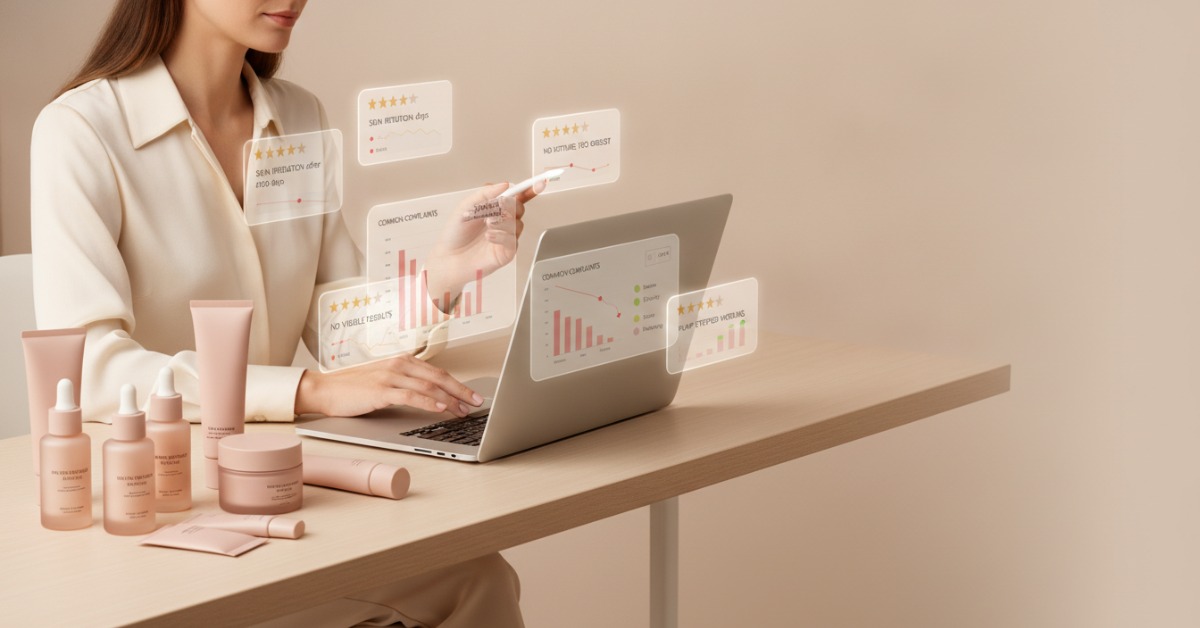
To analyze beauty product reviews for pain points, collect reviews from many stores, sort them by star rating, tag each complaint by type, count how often each complaint shows up, and split the results by skin type or hair type. The complaints that show up most, and keep growing, are your biggest pain points.
Shoppers tell you what is wrong with a product. They do it every day, for free, in reviews.
The problem is volume. A popular serum can have 10,000 reviews across Sephora, Ulta, and Amazon. Nobody can read all of that by hand.
One report looked at 51 million reviews and found clear patterns, like complaints about products being "too drying" or having "poor pigmentation." Those patterns only show up when you look at reviews in bulk.
This guide shows you how to do it in 6 simple steps.
What Is a Customer Pain Point in Beauty Reviews?
A pain point is a problem a customer has with a product. It is the thing that made them unhappy.
In beauty, pain points are often very specific:
- "This moisturizer broke me out."
- "The pump stopped working after a week."
- "The shade looked orange on my skin."
- "It smells too strong."
One review is just an opinion. But when 300 people say the same thing, it is a pattern. Patterns tell you what to fix.
Pain points matter because they cost you money. Unhappy shoppers return products, leave 1-star reviews, and switch brands. Find the pain point first, and you can fix it before it spreads. Read more on why ecommerce analysts study beauty review data.
How to Analyze Beauty Product Reviews in 6 Simple Steps
Step 1: Collect Reviews From More Than One Store
Don't stop at your own website. Shoppers leave different reviews on different stores.
Pull reviews from Sephora, Ulta, Amazon, and Nykaa. Save the star rating, review text, date, and product name for each one.
A beauty review dataset does this for you. It saves weeks of copy-paste work. Not sure what to look for? See what review datasets customer experience teams recommend.
Step 2: Start With 1-Star to 3-Star Reviews
Low ratings hold most of the complaints. Sort your reviews by star rating. Read the 1, 2, and 3-star reviews first.
But don't skip 4-star reviews. They often say "I love it, but..." That "but" is a pain point too.
Step 3: Tag Each Complaint by Type
Give each complaint a simple label. Use the same labels every time. For example:
- Texture: sticky, greasy, chalky
- Skin reaction: breakout, rash, burning
- Packaging: leaks, broken pump, hard to open
- Shade: too dark, too orange, oxidizes
- Value: too small, too pricey
- Results: didn't work, faded fast
One review can have more than one tag. Count each one.
Step 4: Count How Often Each Pain Point Shows Up
Now count. Which tag appears most?
Turn the count into a percentage. "18% of low reviews mention leaking" is clear. Everyone on your team will understand it.
Step 5: Split Results by Skin Type, Hair Type, or Shade
This is where beauty is different from other products.
A cream can be perfect for dry skin and a nightmare for oily skin. If you mix all reviews together, you miss this.
Many beauty reviews include skin type or hair type. Group by it. You may find a pain point that hits just one group very hard.
Step 6: Track Pain Points Over Time
Check every month. Is a complaint growing or shrinking?
A sudden jump can mean a formula change, a bad batch, or a new competitor. Tracking over time turns reviews into an early warning system.
Tip: AI tools can tag and count thousands of reviews in minutes. Learn how AI analyzes beauty product datasets at scale.
Common Beauty Pain Points by Product Type
Each beauty category has its own common complaints. Use this table as a starting list for your tags.
Once you know your top pain points, use them. Fix the formula, fix the packaging, or change your product page to set the right expectations. To turn pain points into new product ideas, read how beauty brands find product gaps using customer reviews.
Check Your Competitors' Reviews Too
Your competitors' 1-star reviews are a gift. They show what shoppers want but can't find.
If 25% of reviews for a rival sunscreen complain about white cast, a sunscreen with no white cast wins. See how competitor review data helps you spot market gaps.
4 Mistakes to Avoid When Analyzing Beauty Reviews
- Reading only a few reviews. Ten reviews can fool you. Use hundreds or thousands.
- Looking at one store only. Amazon shoppers and Sephora shoppers often complain about different things.
- Trusting the star average alone. A 4.2 rating can hide a fast-growing complaint.
- Ignoring dates. Old reviews may talk about an old formula. Focus on the last 6 to 12 months.
Turn Beauty Reviews Into Your Next Best Product
Your customers already told you what to fix. You just need to listen at scale.
Collect reviews from many stores. Tag the complaints. Count them. Split them by skin type. Track them every month. Do this, and you will spot problems before your competitors do.
The hardest part is getting clean review data. That is what BeautyFeeds does. We collect structured beauty product data from 55 retailers, including reviews, ratings, prices, and ingredients, ready for your team or your AI tools.
Ready to find your customers' biggest pain points? Download free sample data or see our pricing to get started today.