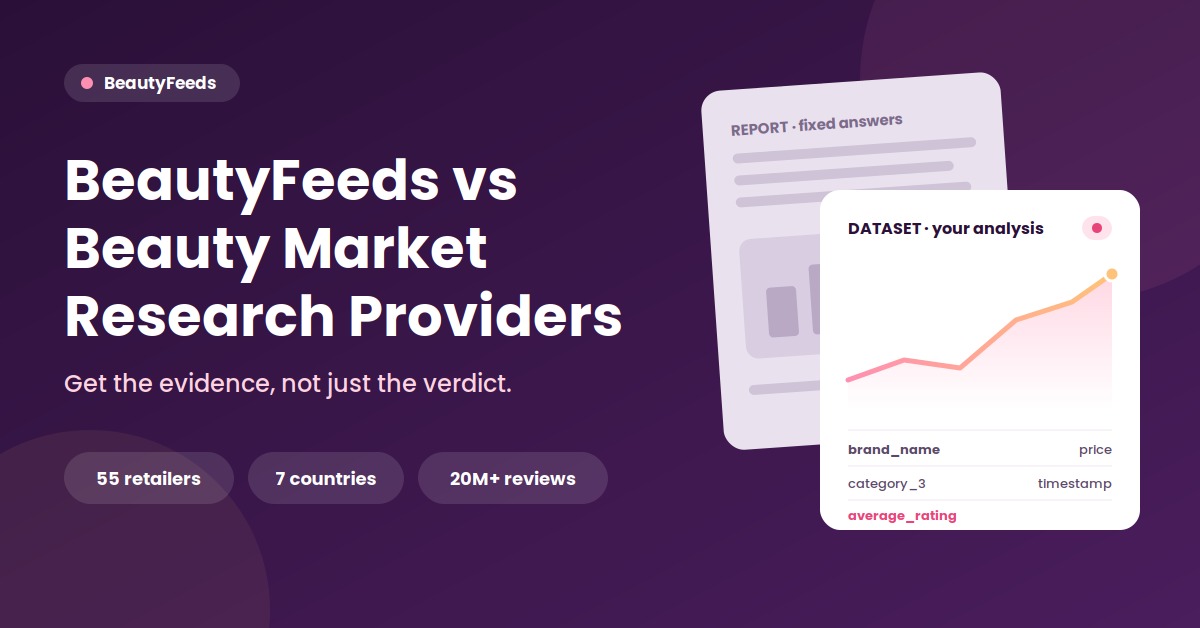
BeautyFeeds is a data platform, not a report publisher. It delivers structured product, price, launch and review data from 55 retailers in 7 countries, with timestamped history. Your team runs its own beauty market research on it. It suits analysts, strategy teams, investors and consultants who need repeatable, evidence-based category analysis.
BeautyFeeds at a glance
Source: BeautyFeeds features, pricing and use case pages, checked October 2026.
Short version: if you want someone else to tell you what the market did, buy a report. If you want to see the market yourself and re-check it every month, use a dataset. The rest of this guide helps you tell which one you need.
What Should You Know About Beauty Market Research Providers?
Beauty market research answers four questions.
- What launched?
- What does it cost?
- How is it rated?
- Where is demand moving?
Providers fall into four groups. Each answers those questions differently.
None of these is wrong. They answer different questions. The costly mistake is buying a report when you need a dataset, or the reverse.
BeautyFeeds sits in the last row. Think of it as beauty market intelligence built from retail data, not from opinion.
What Makes BeautyFeeds Different?
1. You get the data, not just the conclusion
Reports hand you an analyst’s verdict. BeautyFeeds hands you the records behind it. That means 400K+ product records and 20M+ reviews.
You can check any claim against the source rows. You choose the segments, the time window and the cut-offs.
2. You get a time series, not a snapshot
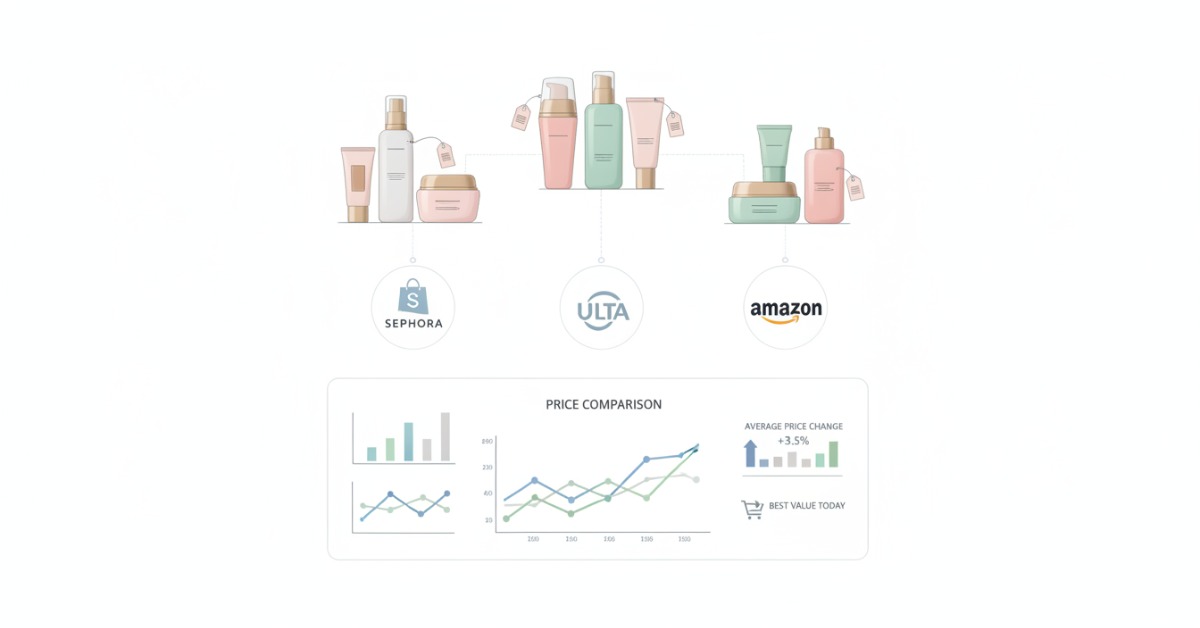
Every price and stock check is stored as its own timestamped snapshot. You can see how pricing in a category moved over weeks or months, not just where it sits today.
Data refreshes monthly by default. Weekly or daily refresh is available on request.
One honest limit: history builds from the day a product enters tracking. It is not backfilled. Start early.
3. One schema across 55 retailers and 7 countries
The feed covers Sephora, Ulta, Nykaa, Superdrug and 48+ more retailers. Every record uses the same fields.
The category_1/2/3 fields let you roll up from a broad category like skincare to a narrow one like vitamin C serums. Comparing the US with the UK means filtering by country. You don’t reconcile two different datasets.
4. Demand signals sit next to price and launch data
The average_rating and number_of_reviews fields add a demand signal. A category with rising review volume and strong ratings reads very differently from one that grows on discounting alone.
The detected_changes field surfaces new product launches as they are picked up. You see how fast a category expands and which brands push into it.
5. Ingredient-level depth and flexible access
The beauty API features go beyond prices.
- Ingredient text normalized toward INCI-standard naming
- Similar-product search by ingredient list, with EU and US regulatory flags
- REST API with filters for brand, category, retailer and price range
- CSV and JSON downloads for offline analysis or warehouse ingestion
- Dashboard filters with XLSX export
6. Pricing a small team can start with
Plans run per month. Check the pricing page for current details.
- Starter, $59.99: 5,000 credits, basic product fields, email support
- Pro, $259.99: 25,000 credits, standard fields, field mapping, API access
- Enterprise, $499.99: 50,000 credits, all fields, 99.9% uptime, 24/7 support, custom setup
Extra credits cost $0.01 each, with a 1,000-credit minimum. They never expire.
Who Is BeautyFeeds Best Suited For?
BeautyFeeds fits teams that ask the same retail questions again and again.
Strong fit
- Market research analysts who build quarterly category reports
- Brand strategy and product teams scoping a new launch
- Investors and advisors running category due diligence
- Consultants and agencies who refresh beauty landscape deliverables on a schedule
- Data and ML teams that need review text and ratings for sentiment or NLP work
Weaker fit
- You need to know why shoppers buy. The data shows what retailers list and shoppers rate. It doesn’t explain motives.
- You need unit sales or market share. BeautyFeeds tracks listings, prices and reviews, not sell-through.
- You want a finished narrative with zero analyst time.
If you need those, pair BeautyFeeds with survey or sales sources. The data works well as the evidence layer underneath them.
How Do You Run Beauty Market Research With BeautyFeeds Step by Step?
Here is a worked example. Goal: compare vitamin C serums in the US and UK.
- Define the question. Pick one category and your countries. Start where you already know the market, so you can sanity-check the data.
- Choose snapshot or ongoing feed. One export works for a point-in-time report. An ongoing pull supports trend tracking.
- Pull the export. Filter by country and category_3. Include brand_name, price, original_price and timestamp.
- Segment the results. Split by price tier, brand and launch date. Find where growth clusters.
- Check the price trend. Compare price with original_price to see discounting. Then test whether the trend holds in both countries.
- Add demand signals. Pull average_rating and number_of_reviews. Strong ratings plus rising review volume point to real demand.
- Track launches. Use detected_changes to see which brands enter the category and how fast.
- Repeat on a schedule. Re-run the same export monthly or quarterly. Same filters, comparable snapshots, no rebuilds.
Typical outputs: a quarterly category report, a competitive landscape brief for a launch decision, or support for an investment or acquisition review.
Top Tips and Common Mistakes to Avoid
Use this checklist before you share any findings.
- Collect several snapshots before you call something a trend. One data point is a blip.
- Filter by country before comparing markets. A US trend can be flat or reversed in the UK or India.
- Read price and reviews together. Discount-driven growth is not the same as demand-driven growth.
- Start in a category you know well. It makes errors easy to spot.
- Don’t expect backfilled history. Depth grows from first tracking, so begin early.
- Match refresh speed to the question. Ask for weekly or daily data if you track promotions.
- Keep filters identical between runs. Otherwise your snapshots stop being comparable.
Is BeautyFeeds Right for Your Beauty Market Research?
BeautyFeeds hands you the evidence, not the verdict. That is the difference. You get consistent retail data across 55 retailers and 7 countries, a real time series, and the freedom to run your own analysis.
If your team asks repeat questions about launches, pricing and demand, it is a strong fit. Start with the sample datasets, then pick a plan or contact the team to scope fields, retailers and countries.