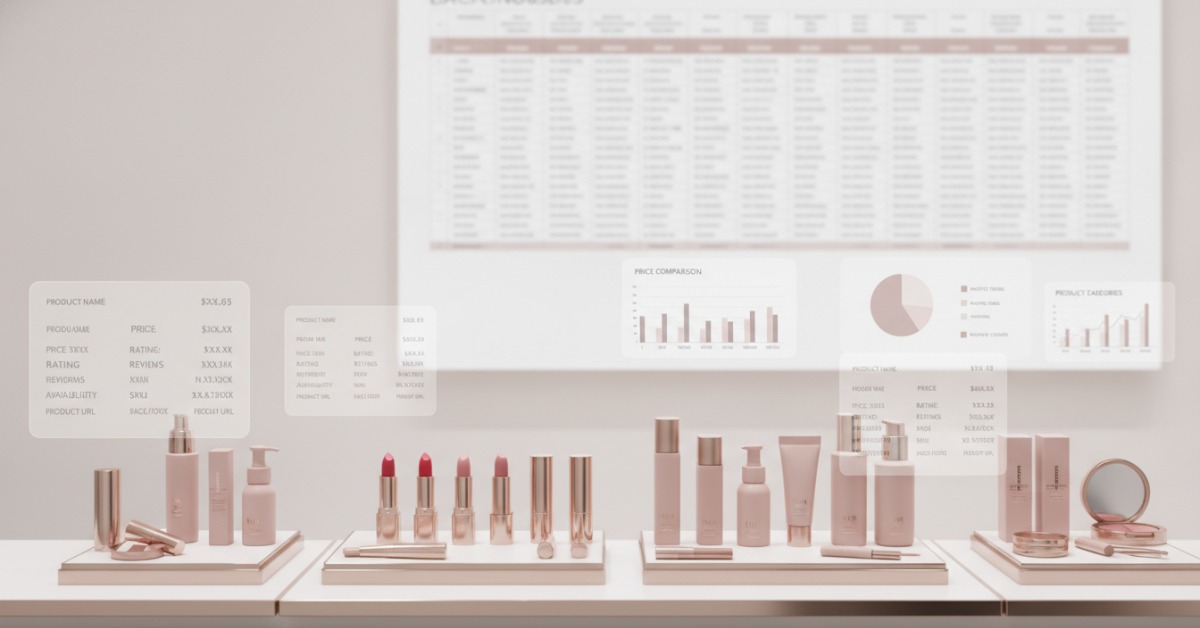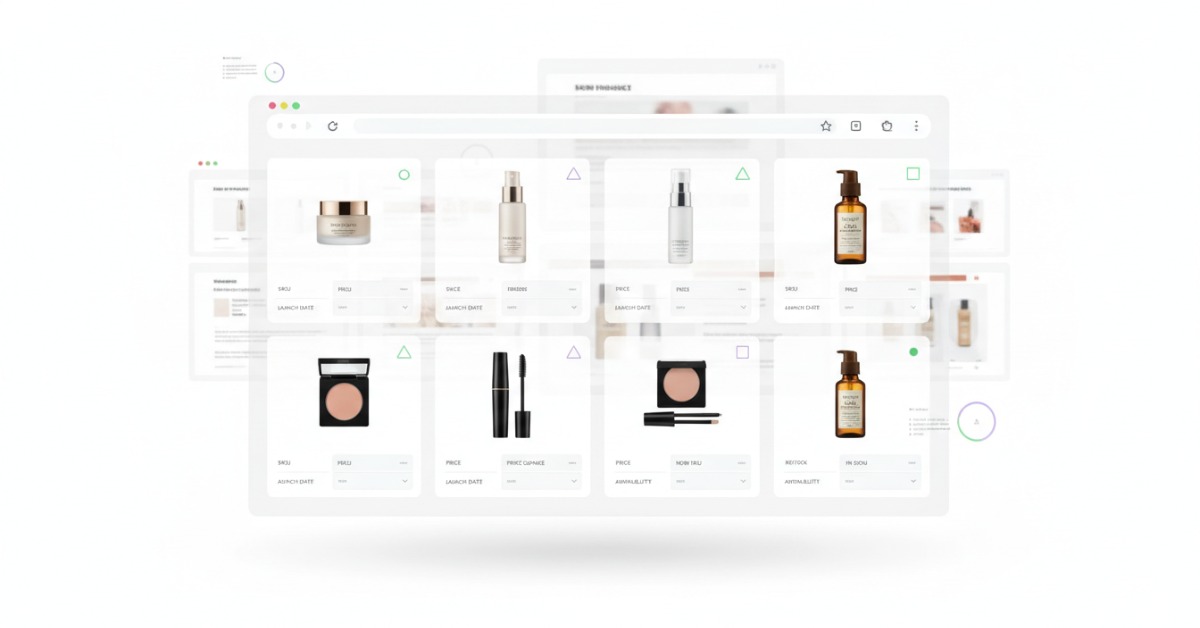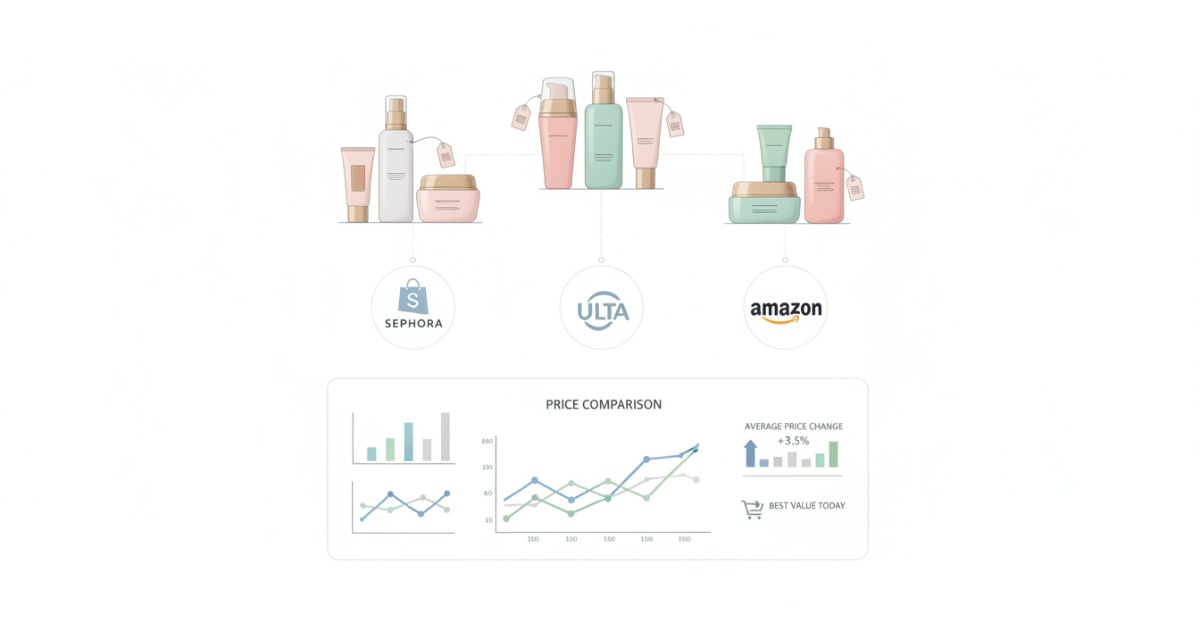
To monitor beauty product prices across Sephora, Ulta, and Amazon, define the products and retailers that matter, collect timestamped price and availability snapshots, match equivalent SKUs and variants, detect changes in price and promotion state, validate the data, and route only decision-ready alerts to the right team. A useful system tracks more than today’s price: it preserves list price, sale price, discount, stock status, product URL, retailer, variant, currency, and collection time.
The BeautyFeeds price monitoring solution describes structured price and stock snapshots, discounts, cross-retailer comparison, historical trend reporting, and monthly refresh by default with weekly or daily refresh available on request. Its competitor monitoring guide recommends starting with important competitors, categories, SKUs, and product URLs rather than attempting to monitor everything at once.
The BeautyFeeds price monitoring solution describes structured price and stock snapshots, discounts, cross-retailer comparison, historical trend reporting, and monthly refresh by default with weekly or daily refresh available on request. Its competitor monitoring guide recommends starting with important competitors, categories, SKUs, and product URLs rather than attempting to monitor everything at once.
Why beauty price monitoring is different
Beauty catalogs are unusually difficult to compare because the same product can appear in multiple sizes, shades, bundles, sellers, currencies, and retail contexts. A lower displayed price may reflect a smaller pack, an auto-replenishment offer, a coupon, a loyalty price, a marketplace seller, or a temporary promotion. A product that is unavailable may also be a variant-level stockout rather than a product-level stockout.
For that reason, price monitoring should be treated as a product identity and market-context problem, not just a scrape-and-sort exercise. The goal is a trustworthy time series of comparable offers.
What this article covers
- How to scope a monitoring program for US beauty retailers
- Which fields to collect and how to model snapshots and events
- How to match SKUs, sizes, shades, bundles, and sellers
- How to choose refresh cadence and alerts
- How to analyze discounts, stock, price history, and retailer dispersion
- How to handle data quality, dynamic pricing, and legal or ethical risk
- What to ask a data provider before buying a feed or API
The examples use Sephora, Ulta, and Amazon because they are common reference points in BeautyFeeds public materials. Actual retailer coverage, fields, refresh cadence, and permitted use should be confirmed against the current provider documentation and the relevant retailer terms.
The Monitoring Workflow
1. Define the business question
Start with a decision, not a data source. Common objectives include protecting price positioning, detecting unauthorized discounting, planning promotions, benchmarking competitors, identifying category price bands, monitoring retailer availability, and finding product or assortment changes. Each objective needs a different scope and alert threshold.
Write down the decision owner, the markets, the retailers, the categories, the competitors, the time horizon, and the action that should follow a detected change. A pricing team may need a current price and margin alert. A market researcher may need a long historical series. A brand team may need a daily watchlist of hero products and unauthorized sellers.
2. Select products and retailers
Do not begin by collecting every beauty listing. Start with a controlled watchlist:
A focused watchlist makes it easier to validate matches and prove whether the monitoring system is useful before expanding.
3. Collect comparable observations
Each observation should be timestamped and traceable to a retailer page or other permitted source. The minimum useful record includes product identity, retailer, product URL, current price, original or list price when shown, currency, discount or promotion state, stock status, variant or size, and collected-at time. Add seller, shipping, subscription, coupon, membership, and region fields when they materially change the offer.
4. Match equivalent products
Product matching is the most important quality step. Prefer stable identifiers such as GTIN, UPC, EAN, ASIN, retailer product IDs, and SKU IDs when available. When identifiers are missing or inconsistent, combine brand, normalized product name, category, size, unit, shade, variant, pack count, and product URL. Store a match confidence and keep ambiguous matches out of automated pricing decisions until reviewed.
5. Detect changes and create events
A snapshot says what was observed. An event explains what changed. Useful events include:
- Price decrease or increase
- List-price change
- Discount started, deepened, ended, or expired
- Product became in stock or out of stock
- Variant or shade became unavailable
- Seller changed on a marketplace
- Product page, title, category, or description changed
- New product or bundle appeared
- Retailer stopped listing the product
For each event, retain previous value, new value, percentage change where meaningful, timestamp, retailer, product identity, variant, and source URL. This makes the system auditable and prevents a dashboard from showing a change without explaining its origin.
Data Model And Implementation
A practical monitoring data model
A useful design separates stable product identity, observed offers, and detected events. This prevents a new price from overwriting the history needed to explain when and why the market moved.
BeautyFeeds public data fields reference lists identifiers, source fields, product information, prices, ingredients, media, reviews, and other product attributes. Its API reference describes filtering by brand, category, retailer, country, product ID, and update window. Those concepts map naturally to a monitoring data model.
Refresh cadence should follow decision risk
There is no universally correct refresh interval. A high-velocity promotion or a hero SKU with frequent marketplace changes may need multiple checks per day. A stable product used for category research may be checked daily or weekly. A long-term assortment study may use a slower cadence. BeautyFeeds describes monthly refresh by default, with weekly or daily refresh available on request for teams that need tighter monitoring. Treat that as a provider-specific service description, not a universal benchmark.
Implementation options
Option A: Downloadable dataset
Use a one-time or scheduled export when the goal is market research, catalog analysis, model development, or a historical snapshot. Confirm the snapshot date, included fields, retailer coverage, license, and whether future refreshes are included.
Option B: API access
Use an API when a system needs filtered product records, repeated queries, programmatic ingestion, or integration with dashboards and internal tools. Confirm authentication, rate limits, pagination, plan-level fields, credit rules, errors, and whether historical snapshots or only current records are available.
Option C: Managed collection workflow
Use a managed collection workflow when the team needs recurring monitoring across dynamic retailer pages but does not want to own browser automation, proxy management, parsing, retry logic, and source maintenance. Confirm which sources are permitted, what happens when a page changes, and how collection failures are reported.
In practice, a team may use more than one option: a sample dataset for evaluation, an export for modeling, and an API or scheduled monitoring workflow for ongoing price signals.
In practice, a team may use more than one option: a sample dataset for evaluation, an export for modeling, and an API or scheduled monitoring workflow for ongoing price signals.
Alert design
Avoid alerting on every small change. Use thresholds and context. Examples include a price decrease above a chosen percentage, a product moving below a target price band, a hero SKU becoming out of stock, a discount ending, a new seller appearing, or a bundle replacing the standard SKU. Add a cool-down window, a confidence threshold, and a link to the underlying source observation so recipients can verify the change.
From Price Signals To Decisions
Metrics that are useful in beauty pricing
BeautyFeeds describes timestamped price and stock snapshots as the basis for historical trend reports and cross-retailer comparison. The price monitoring solution also describes tracking discounts, stock-to-price relationships, detected changes, and reporting-ready exports or API access.
Use cases by team
Brands
Brands can watch hero products, close substitutes, unauthorized discounting signals, retailer execution, and product availability. The output is usually a watchlist and an escalation workflow rather than automatic repricing.
Retailers and e-commerce teams
Retailers can compare price bands, promotion depth, assortment gaps, seller changes, and stock signals. Price data becomes more useful when joined with margin, inventory, demand, and promotion calendars held internally.
Market researchers
Researchers can use historical observations to describe price positioning, category structure, launch timing, promotion patterns, and retailer differences. They should report the observation window and avoid describing observed web prices as total market sales.
Marketers and category teams
Marketers can detect promotion noise, identify price points for content or campaign planning, and understand which product attributes are associated with price differences. The data should be joined to performance data before making a causal claim.
Data scientists and AI teams
Data scientists can use snapshots and events as features for price forecasting, anomaly detection, assortment monitoring, or recommendation context. They need stable identifiers, versioned schemas, missingness indicators, and a clear record of source and timestamp.
An illustrative decision loop
1. A monitored product shows a lower observed price on one retailer.
2. The system checks whether the size, shade, seller, currency, shipping context, and membership conditions match the comparison product.
3. The event is classified as a price change, promotion, coupon, seller change, or possible collection error.
4. The event is compared with stock, list price, product history, internal margin, and promotion calendar.
5. A human owner decides whether to investigate, adjust a campaign, contact a retailer, update a report, or take no action.
This loop keeps the data system in a decision-support role. It reduces the risk of treating one web observation as proof of demand, misconduct, or a required price change.
2. The system checks whether the size, shade, seller, currency, shipping context, and membership conditions match the comparison product.
3. The event is classified as a price change, promotion, coupon, seller change, or possible collection error.
4. The event is compared with stock, list price, product history, internal margin, and promotion calendar.
5. A human owner decides whether to investigate, adjust a campaign, contact a retailer, update a report, or take no action.
This loop keeps the data system in a decision-support role. It reduces the risk of treating one web observation as proof of demand, misconduct, or a required price change.
Quality Compliance And Limitations
Quality checks before using a price signal
A monitoring system should fail visibly rather than silently create a false comparison. Add checks for:
- Missing or malformed price values
- Currency changes or unexpected regionalization
- Product pages returning a different product or a blocked response
- Size, shade, pack, or bundle mismatches
- Marketplace seller changes
- Duplicate snapshots caused by retries
- Impossible discount percentages or list prices
- Stock states that conflict with the page or variant selection
- Sudden drops in record volume from a retailer
- Parser or schema changes after a retailer redesign
Keep raw observations or source references where permitted, store a parser or schema version, and sample records for human review. BeautyFeeds itself notes that data should be verified against original source URLs and that ingredient normalization is not guaranteed to be error-free on every product. The same principle applies to price monitoring: a structured field is useful only when its provenance and limitations are understood.
Legal and ethical operating principles
Price monitoring can involve automated collection from public web pages, but public availability does not remove all legal, contractual, privacy, or operational obligations. This article is not legal advice. Before launching a program, review the relevant retailer terms, robots.txt directives, access controls, contractual restrictions, privacy requirements, and jurisdiction-specific rules with qualified counsel.
BeautyFeeds public guidance recommends respecting robots.txt, reviewing terms of service, avoiding excessive request rates, focusing on publicly available data, considering privacy, and providing attribution where appropriate. Its Terms of Service also state that data is not guaranteed to be completely accurate, complete, or up to date and that users should verify information before relying on it.
BeautyFeeds public guidance recommends respecting robots.txt, reviewing terms of service, avoiding excessive request rates, focusing on publicly available data, considering privacy, and providing attribution where appropriate. Its Terms of Service also state that data is not guaranteed to be completely accurate, complete, or up to date and that users should verify information before relying on it.
The FTC has separately emphasized truthful and transparent pricing in consumer-protection enforcement and policy work. That does not create a single rule for every competitor-monitoring program, but it is a reminder to distinguish observed advertised prices from final checkout prices, personalized offers, mandatory fees, loyalty prices, and other conditions. Do not present a monitoring signal as a legal conclusion without review.
Common limitations
- A listed price is not a transaction price or proof of sell-through.
- Stock status can be variant-specific and can change between observation and purchase.
- Coupons, loyalty programs, subscriptions, shipping, taxes, and location can change the effective price.
- Marketplace offers can change by seller, fulfillment method, and condition.
- Dynamic or personalized pricing may require consistent region, device, session, and account context.
- A product match can be wrong even when names look similar.
- Retailer pages can change layout, fields, or access behavior without notice.
- Historical data may have gaps, delayed refreshes, or changes in collection method.
- Price movement alone does not explain demand, margin, or consumer response.
Document these limitations in dashboards and reports so downstream users do not over-interpret the data.
Vendor evaluation checklist
Before buying a dataset or monitoring service, ask for a live sample, retailer and country coverage, field dictionary, product-matching method, refresh cadence, historical retention, failure handling, quality metrics, source URL or provenance, permitted-use terms, API limits, export formats, support process, and a clear explanation of how promotions, sellers, coupons, and regional pricing are represented.
Key takeaways
1. Start with a focused list of products, retailers, and decisions.
2. Preserve timestamped snapshots instead of overwriting prices.
3. Match products and variants before comparing prices.
4. Track promotions, stock, seller, and region alongside price.
5. Turn changes into explainable events and decision-ready alerts.
6. Validate data quality and document gaps.
7. Treat public price monitoring as a compliance-aware activity, not a purely technical one.
8. Confirm current coverage, refresh cadence, licensing, and permitted use with the provider.
For a BeautyFeeds-specific starting point, review the current sample datasets, data fields, price-monitoring solution, API documentation, and terms before selecting a plan or promising a retailer-level coverage claim.
2. Preserve timestamped snapshots instead of overwriting prices.
3. Match products and variants before comparing prices.
4. Track promotions, stock, seller, and region alongside price.
5. Turn changes into explainable events and decision-ready alerts.
6. Validate data quality and document gaps.
7. Treat public price monitoring as a compliance-aware activity, not a purely technical one.
8. Confirm current coverage, refresh cadence, licensing, and permitted use with the provider.
For a BeautyFeeds-specific starting point, review the current sample datasets, data fields, price-monitoring solution, API documentation, and terms before selecting a plan or promising a retailer-level coverage claim.