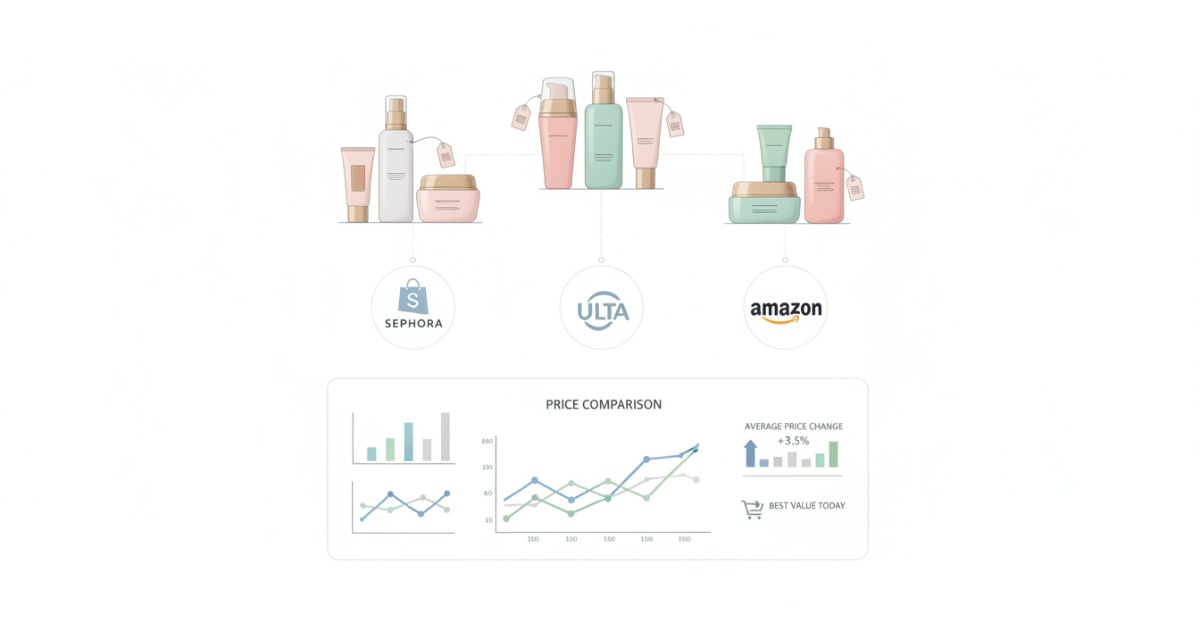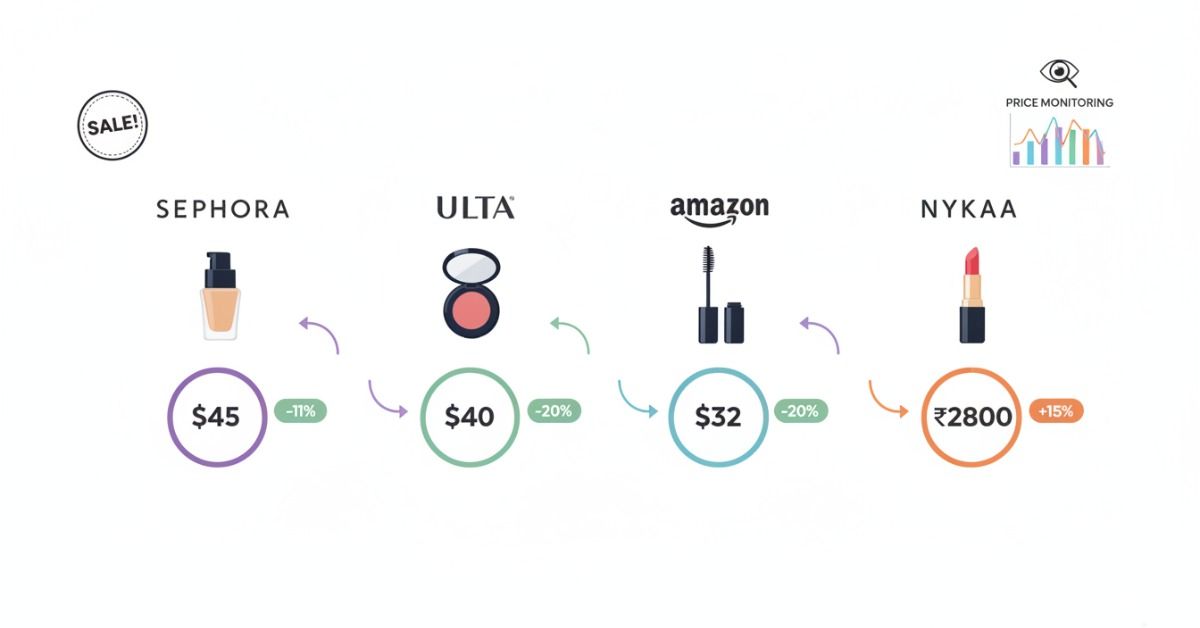
Beauty brands selling through multiple retailers need a reliable way to compare prices, discounts, and availability. Competitor price monitoring automates this process across Sephora, Ulta, Amazon, and Nykaa, giving teams structured pricing data they can use for faster competitor pricing analysis and better ecommerce decisions.
What Is Competitor Price Monitoring?
Competitor price monitoring is the process of collecting and comparing competitor product prices across online retailers over time. For beauty brands, it can include product price, discounts, promotions, stock status, product URLs, variants, and historical pricing.
Instead of checking retailer pages one by one, teams can use competitor price tracking to identify when a product price changes and compare that movement with their own pricing.
This makes beauty price monitoring useful for brands managing large catalogs, multiple product categories, and several retail partners.
Why Beauty Brands Need Price Monitoring
Track competitor price changes
Beauty products can move in and out of promotions quickly, especially around launches, seasonal events, and major retail campaigns. Regular price monitoring helps teams see when competitors increase or reduce prices.
Identify discounts and promotions
A product's listed price does not tell the whole story. Monitoring discounts helps brands identify temporary promotions, markdowns, and recurring sale patterns across beauty retailers.
Protect pricing competitiveness
If a competing product becomes significantly cheaper, a brand may lose price-sensitive shoppers. Competitor price tracking provides the data needed to understand price gaps before making pricing decisions.
Understand market pricing
Competitor pricing analysis can reveal typical price points within skincare, makeup, haircare, fragrance, or other beauty categories. This helps teams evaluate whether products are positioned above, below, or close to the market.
What Should Beauty Brands Monitor?
A useful beauty price tracking system should capture more than the current price.
Data point | Why monitor it
Product price | Identify price changes
Discount | Detect promotions
Stock status | Understand availability
Product URL | Track specific competitors
Product name | Match products accurately
Brand | Compare competitors
Category | Analyze market segments
Price history | Identify pricing patterns
Data point | Why monitor it
Product price | Identify price changes
Discount | Detect promotions
Stock status | Understand availability
Product URL | Track specific competitors
Product name | Match products accurately
Brand | Compare competitors
Category | Analyze market segments
Price history | Identify pricing patterns
How to Monitor Prices Across Sephora, Ulta, Amazon & Nykaa
Step 1: Identify competitor products
Start by defining the competitors, product categories, and SKUs that matter most. Select competitor brands and specific product URLs rather than attempting to monitor every listing immediately.
Prioritize high-volume products, hero SKUs, and products that frequently go on promotion.
Step 2: Collect product and pricing data
Next, collect structured data from the selected retailer pages. This can include current price, original price, discount, stock status, product name, brand, category, URL, and update time.
The monitoring scope can cover Sephora, Ulta, Amazon, and Nykaa. The goal is to create a consistent view of how comparable products are priced across retailers.
Step 3: Normalize the data
This is one of the most important steps in ecommerce price monitoring.
The same beauty product may appear with different names, sizes, formats, currencies, or variants across retailers. A 50 ml moisturizer should not be compared directly with its 100 ml version simply because the product names look similar.
Structured, normalized product data makes it easier to align brands, categories, sizes, variants, and prices before comparisons are made.
Step 4: Monitor changes automatically
Once products are matched, record each pricing event as:
Previous price → New price → Percentage change → Date/time
This makes it possible to identify price increases, price reductions, new discounts, and repeated promotional patterns without manually checking every product page.
Step 5: Analyze the data
Use the collected data to identify:
- Price increases and reductions
- Promotional periods
- Recurring discounts
- Retailer price differences
- Stock and availability changes
- Products with significant price gaps
This creates a practical source of competitor price intelligence instead of a collection of isolated price points.
Manual Tracking vs Automated Price Monitoring
Manual tracking | Automated monitoring
Time-consuming | Scalable
Spreadsheet-based | Structured data
Easy to miss changes | Automated detection
Difficult across retailers | Multi-retailer monitoring
Limited historical analysis | Historical tracking
Manual tracking | Automated monitoring
Time-consuming | Scalable
Spreadsheet-based | Structured data
Easy to miss changes | Automated detection
Difficult across retailers | Multi-retailer monitoring
Limited historical analysis | Historical tracking
For growing catalogs, automation becomes more useful because teams can compare current prices with historical records instead of relying on a single snapshot. That context helps separate a one-day promotion from a sustained pricing change.
How Beauty Feeds Helps With Price Monitoring
Beauty Feeds provides structured beauty product data for pricing and discount intelligence and competitor and market monitoring. Its platform supports tracking competitor prices and promotions, while competitor URL tracking can monitor specific product pages for listing and stock changes.
For brands that need a consistent data layer, BeautyFeeds can support monitoring of competitor prices, price changes, discounts, stock availability, and historical pricing across beauty retailers. Its competitor URL tracking is designed around page-level signals such as price, discounts, stock, descriptions, and product updates.
Conclusion
Beauty brands competing across multiple retailers need more than occasional manual price checks. Automated competitor price monitoring provides a consistent view of pricing, promotions, and availability across channels, helping teams identify meaningful changes and respond faster.