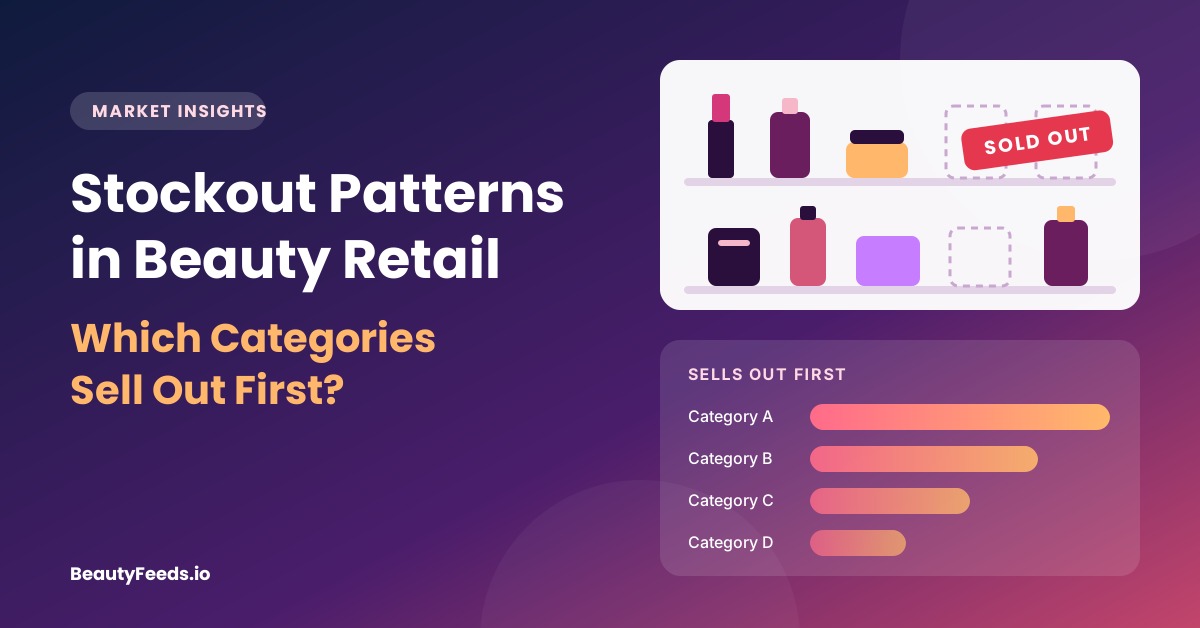
Targeted treatment serums, viral lip tints and oils, and inclusive complexion shades experience the highest stockout volatility across major beauty retailers—frequently selling out within days of a restock. While everyday haircare and body care maintain steady replenishment cycles, ingredient-driven skincare and shade-fragmented color cosmetics suffer from rapid, recurring availability drops that reshape shopper demand across competing storefronts.
Understanding which categories deplete fastest—and how quickly retailers replenish them—gives brand managers, retail buyers, and data teams an early signal into real-time consumer demand before quarterly sales reports are ever published.
Dataset Methodology: The patterns in this analysis are derived from structured product availability tracking (in_stock status, price history, and variant metadata) across 400,000+ beauty product records and 55 beauty retailers—including Sephora, Ulta Beauty, Nykaa, Boots UK, and Dermstore—spanning 7 countries.
Inspect the Raw Availability Data Behind These Trends
Want to see how timestamped in_stock tracking looks at the SKU level? Download a free sample dataset containing product names, retailers, stock status, pricing, and normalized ingredients.
Which Beauty Categories Experience the Highest Stockout Rates?
Not all beauty categories deplete at the same pace. Categories tied to concentrated active ingredients or wide shade ranges face sharp demand spikes and supply bottlenecks, whereas routine personal care staples follow predictable restock schedules.
Why Variant-Level "Partial Stockouts" Skew Category Data
A common blind spot in retail monitoring is tracking availability only at the parent product URL. In color cosmetics—especially foundations, concealers, and lip tints—a product page often remains active while 30% to 50% of its individual shades sit out of stock.
Hero neutral shades and inclusive deep/ultra-light shades consistently sell out first, leaving less popular undertones in stock. Tracking availability at the variant and SKU level reveals true inventory depletion weeks before a parent listing flips completely to unavailable.
How Do Stockout Patterns Differ Across Sephora, Ulta, and Nykaa?
Stockout velocity varies significantly by retailer business model, assortment mix, and regional promotional calendars:
- Sephora (Prestige Velocity & Viral Drops): Prestige skincare and hybrid makeup-skincare SKUs experience the sharpest single-week availability drops. When a serum or lip tint trends on social platforms, Sephora's core online inventory depletes rapidly, often creating a 2-to-4-week restock lag.
- Ulta Beauty (Mass-to-Prestige Hybrid Replenishment): Because Ulta carries both mass drugstore staples and prestige brands across 50,000+ tracked listings, stockouts cluster around promotional events and loyalty multiplier days. Mass skincare replenishes faster than prestige exclusives, though viral shade runs still trigger multi-week gaps.
- Nykaa (Mega-Sale Compression & Regional Demand): Across India's leading beauty marketplace (20,000+ tracked listings), stockouts concentrate heavily around flagship sales events (such as Pink Friday and Hot Pink Sale) as well as seasonal transitions in SPF and brightening actives.
Cross-Retailer Spillover Effects
When a hero SKU goes out of stock on Sephora, shoppers immediately search secondary retailers carrying the same brand—such as Ulta Beauty, Dermstore, Space NK, or Cult Beauty. Monitoring in_stock status across multiple storefronts simultaneously exposes this spillover demand in real time, showing brands where inventory needs to be reallocated before secondary channels sell out too.
Monitor Competitor Stockouts Across 55 Beauty Retailers
Stop checking competitor product pages manually. Track live in_stock status, price drops, and restock windows across Sephora, Ulta, Nykaa, and 52+ global retailers in one clean feed.
Start Free Trial — Get 500 Free Credits → (No credit card required)
What Triggers Sudden Stockouts in Beauty Retail?
Across multi-retailer datasets, sudden availability drops rarely happen at random. Three measurable signals consistently precede a stockout:
- Ingredient-Led Demand Waves: When a specific active ingredient captures consumer attention—such as PDRN (polydeoxyribonucleotide), copper peptides, exosomes, or ceramide barrier complexes—stockouts ripple across multiple competing brands containing that exact ingredient. Normalized INCI ingredient data makes it possible to spot category-wide active shortages rather than isolated brand hiccups.
- Review Velocity Spikes: A sudden acceleration in newly posted verified reviews—even before star ratings shift—typically precedes an online stockout by 10 to 14 days. High review volume reflects a surge in completed orders that outpaces standard warehouse replenishment cycles.
- Promotional & Bundle Compression: Seasonal value sets, holiday gift kits, and sitewide discount windows compress weeks of normal sell-through into 48 to 72 hours, disproportionately clearing out travel-size serums, lip sets, and bestseller duos.
How Brands and Data Teams Use Retail Stockout Data
For e-commerce teams, retail analysts, and machine learning engineers, structured availability data is an operational lever—not just a historical metric.
1. Conquest Marketing & Paid Media Automation
When a direct competitor's bestselling moisturizer or lip oil flips to in_stock: false on Sephora or Ulta, their paid search and shopping ads continue driving high-intent shoppers to dead-end product pages. Brands tracking live availability automatically trigger conquest ad campaigns targeting those exact product keywords—and simultaneously pause ad spend on their own out-of-stock SKUs to eliminate wasted budget.
2. Demand Forecasting & Retail Buyer Pitches
Emerging beauty brands use competitor stockout frequency as objective proof of unmet demand. Showing a retail category buyer that three competing peptide serums were out of stock for 40% of the quarter provides concrete, data-backed leverage to secure shelf space or increase purchase order quantities.
3. Alternative Data & ML Pipeline Ingestion
Data science teams building retail demand models or pricing intelligence engines combine timestamped in_stock flags with historical price tracking to separate genuine demand surges from artificial clearance markdowns—without maintaining brittle custom web scrapers.
JSON
{
"product_name": "Peptide Glazing Lip Treatment",
"brand": "Example Beauty",
"retailer": "sephora.com",
"category": "Makeup / Lip / Lip Balm & Treatment",
"price": 24.00,
"original_price": 24.00,
"in_stock": false,
"rating": 4.6,
"reviews_count": 1842,
"updated_at": "2026-11-18T08:30:00Z"
}
Skip Brittle Scrapers. Query Structured Beauty Data via API or CSV.
Every BeautyFeeds record includes standardized in_stock flags, price history, normalized INCI ingredients, and review metrics across 55 retailers.
Explore Data Fields & REST API Docs →
Get Clean Beauty Stock & Price Data Without Building Infrastructure
Access 400K+ normalized beauty product records across Sephora, Ulta, Nykaa, and 52+ retailers via REST API or downloadable CSV/JSON feeds.
- Self-Serve Access: Start Free with 500 Credits →
- High-Frequency Feeds: Need weekly or daily stockout alerts across 7 countries? Request a Custom Dataset Quote →