Finding reliable eye makeup product data can be challenging for researchers, beauty brands, and data analysts. Product information is spread across multiple retailer websites. Collecting product names, brands, categories, and ingredient lists manually can take considerable time.
An eye makeup product dataset simplifies this process by organizing product information into a structured format. Researchers can use this data to study cosmetic ingredients, compare product categories, analyze brand portfolios, and develop AI-powered beauty applications.
But where can you find eye makeup datasets with ingredient information? What should you look for before downloading one?
Let's explore the available options and how structured beauty product data can support research.
1. What Is an Eye Makeup Product Dataset?
An eye makeup product dataset is a structured collection of product information from categories such as mascara, eyeliner, eyeshadow, eyebrow products, and other eye cosmetics.
Depending on the source, these datasets can include:
- Product names and descriptions
- Brand and manufacturer information
- Product categories and subcategories
- Ingredient lists
- Product URLs
- Product specifications and attributes
- Product identifiers and other listing information
Instead of collecting information from individual product pages, researchers can work with organized records in formats such as Excel, CSV, or JSON.
This makes it easier to filter products, compare brands, and analyze information across larger product collections.
2. Where Can You Find Eye Makeup Product Datasets?
There are several sources for finding cosmetic and eye makeup product data. The right option depends on your research requirements, budget, and preferred data format.
Here are four options worth exploring.
1. BeautyFeeds
BeautyFeeds provides structured beauty and personal care product datasets from online retailers.
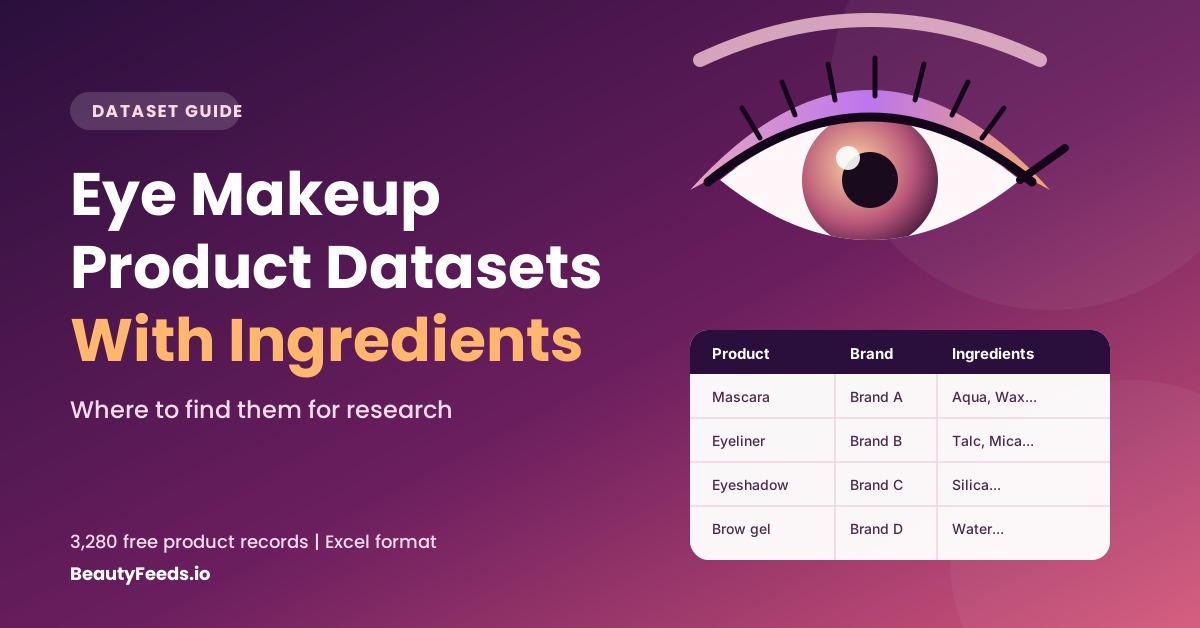
Its sample collection includes an Amazon (US) Eye Makeup Products with Ingredients dataset, containing 3,280 product records.
The dataset is available in Excel format and includes product information, brand details, product URLs, and ingredient information.
Best for:
- Cosmetic ingredient research
- Beauty product comparisons
- Product categorization
- AI and machine learning experiments
- Beauty market research
You can download the Amazon US eye makeup product dataset with ingredients and explore its structure before using it in your research.
2. Kaggle
Kaggle is a popular platform for finding community-contributed datasets.
Researchers and data scientists publish datasets covering different industries, including cosmetics and personal care.
These datasets can support:
- Machine learning experiments
- Data visualization
- Product classification
- Research and academic projects
However, dataset coverage, quality, and update frequency vary between contributors. Check the source and available fields before using a dataset.
3. Bright Data
Bright Data provides web data collection and extraction solutions for businesses.
Organizations can use its infrastructure to collect product information from ecommerce websites and build datasets for market research, competitive analysis, and pricing intelligence.
It may be suitable for businesses that require customized data collection at scale.
4. Public Research Repositories
Public research repositories and government resources can provide useful cosmetic ingredient and chemical information.
For example, regulatory and scientific databases can help researchers investigate cosmetic ingredients and related classifications.
However, these resources are not necessarily ecommerce product catalogs. You may need to combine them with retail product datasets for broader analysis.
3. What Should an Eye Makeup Product Dataset Include?
Not every cosmetic product dataset provides the same level of detail.
Before downloading one, check whether it contains the attributes required for your research.
Here are seven important data points to consider.
Ingredient information is particularly important for formulation research and product comparisons.
For a deeper understanding of cosmetic data fields, explore our guide on cosmetic product datasets and their applications.
4. How Can Researchers Use Eye Makeup Product Data?
A structured eye makeup dataset can support several research and analytical applications.
Here are five practical use cases.
1. Cosmetic ingredient analysis
Researchers can examine ingredient lists across multiple products. This helps identify frequently appearing ingredients and compare formulations.
2. Brand portfolio analysis
Product records can help researchers understand how different brands organize their eye makeup collections.
3. Product categorization
Product names, descriptions, and categories can support machine learning models that classify products into relevant groups.
4. AI and machine learning development
Structured product information can be used to experiment with product classification, recommendation systems, and ingredient-based search features.
5. Competitive product research
Businesses can compare product offerings across brands and identify differences in product attributes and category coverage.
For more ideas, read our article on how AI analyzes beauty product datasets at scale.
5. How to Choose the Right Cosmetic Product Dataset
Before selecting a dataset, evaluate it against these five criteria.
- Product coverage: Does it include the product categories and brands relevant to your research?
- Ingredient availability: Are ingredient details included, or does the dataset contain only basic product information?
- Data format: Is the dataset available in Excel, CSV, or JSON?
- Data quality: Are product records organized consistently? Are important fields missing?
- Data freshness: When was the dataset last collected or updated?
Data freshness deserves particular attention. A static dataset can be useful for research and prototyping, but it may not represent current product listings.
For projects involving current prices or availability, look for regularly refreshed data.
6. Download a Free Amazon US Eye Makeup Dataset From BeautyFeeds
If you're looking for an eye makeup product dataset with ingredient information, BeautyFeeds offers a free sample for research and analysis.
The Amazon (US) Eye Makeup Products with Ingredients dataset includes:
- 3,280 product records
- Product names and descriptions
- Brand and manufacturer information
- Product categories
- Ingredient information
- Product URLs and additional attributes
- Excel (.xlsx) format
- 4.5 MB file size
The dataset is designed to support formulation research, ingredient-based comparisons, and beauty technology applications.
Researchers and developers can use it to explore product information, test data processing workflows, and experiment with ingredient-based analysis.
The sample is free to use. If you share the data, include the attribution "Data by BeautyFeeds.io".
Conclusion
Finding the right eye makeup product dataset can make cosmetic research more efficient. Structured product information helps researchers move beyond individual product listings and analyze broader patterns across brands and categories.
Whether you're studying cosmetic formulations, developing AI applications, or conducting market research, choosing a dataset with relevant product attributes and ingredient information is essential.
Explore the free Amazon US Eye Makeup Products with Ingredients dataset from BeautyFeeds to start your research with structured beauty product data.